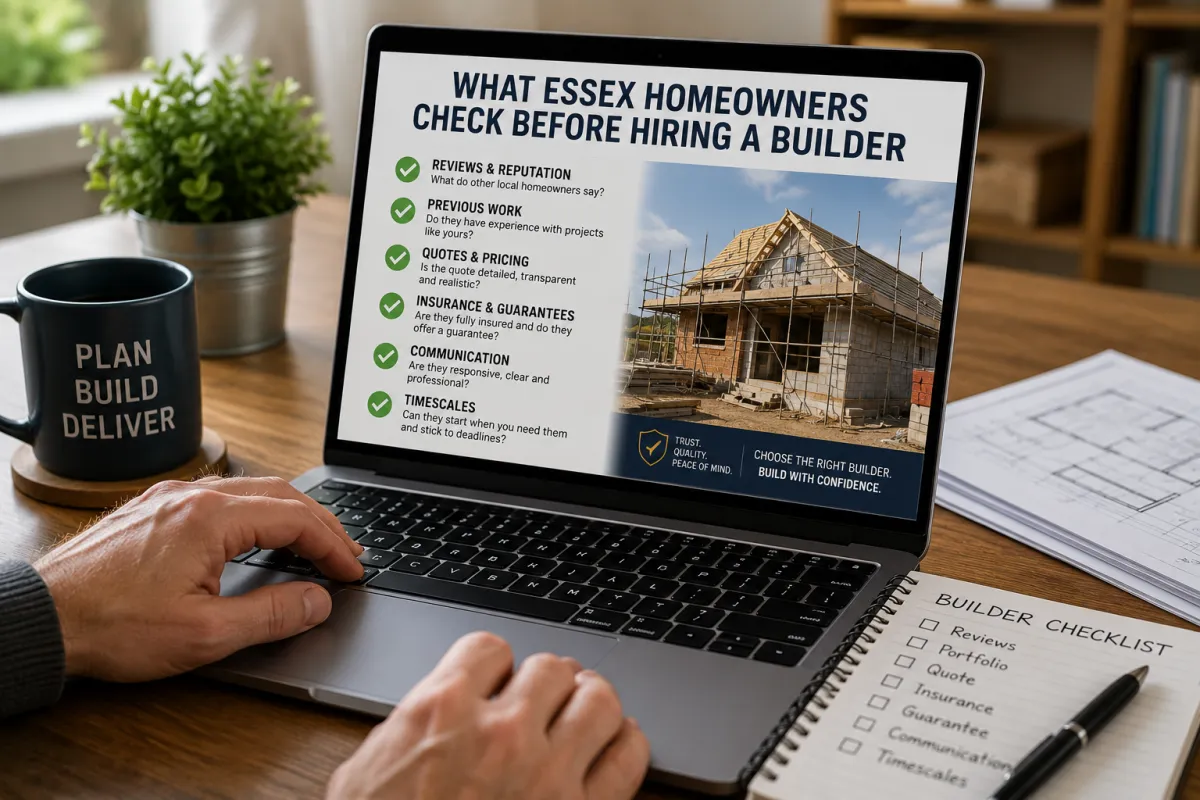
What Essex Homeowners Check Before Hiring a Builder
Hiring a builder can feel more personal than hiring almost any other business.
The customer isn’t buying something they can return to a shop.
They may be removing the back of their house, opening structural walls or taking the roof apart. Their kitchen could be unusable for weeks. Their children may be sleeping metres from a working site.
A large part of their savings may be tied to a project that exists only as drawings and promises.
The homeowner needs to believe that the builder can complete the work.
They also need to believe that the builder will answer the phone when something changes, protect the property, manage the money responsibly and return to fix problems at the end.
A good website begins answering those concerns before the first meeting.
THE FIRST QUESTION IS SIMPLE: ARE YOU A GENUINE BUSINESS?
A polished logo isn’t enough.
The website should provide clear business information:
Trading name
Legal company name where relevant
Business address or genuine service base
Telephone number
Email address
Company registration number where applicable
VAT status where applicable
Names of business owners
Insurance details
Trade association memberships
Areas covered
Homeowners may cross-check these details elsewhere.
Government guidance recommends comparing traders, checking experience and certifications, reading verified reviews and confirming information through trade associations or independent sources. It also confirms that traders carrying out home improvement work must use reasonable care and skill.
Make verification easy.
A builder shouldn’t expect someone to transfer a large deposit to a business they can’t identify properly.
BUILDERS NEED PROOF OF SIMILAR WORK
A homeowner planning an extension wants to know whether the builder has completed comparable extensions.
A bathroom photograph doesn’t answer that.
A strong portfolio should include two or three recent examples of each main project type:
Rear extensions
Side-return extensions
Two-storey extensions
Loft conversions
Garage conversions
Structural alterations
Full renovations
Period property work
Commercial refurbishments
Citizens Advice recommends asking traders for two or three recent examples of similar work and contacting previous customers, since written references may not always be genuine.
The website can support this by showing detailed case studies and offering references at the appropriate stage.
A useful sentence might read:
“Once we’ve established that your project is a suitable fit, we can provide contact details for recent customers who have agreed to discuss similar work.”
That protects previous customers from receiving unnecessary calls while still demonstrating openness.
REVIEWS NEED TO DESCRIBE THE WHOLE PROJECT
A review saying “great builder” gives limited reassurance.
A review describing a four-month extension tells the reader far more.
Useful reviews mention:
The project
The town
Communication
Timekeeping
Site cleanliness
Budget management
Changes
Subcontractors
Problem-solving
Snagging
Final paperwork
For example:
“We used the team for a rear extension and complete ground-floor renovation in Chelmsford. We remained in the house with two children, so communication and tidiness mattered. We received weekly updates, changes were agreed in writing and the snagging items were completed without chasing.”
That review addresses the anxieties of another family planning similar work.
Place project-specific reviews beside the relevant service and case study.
SHOW WHAT INSURANCE THE BUSINESS HOLDS
“Fully insured” is vague.
Customers should be able to ask which policies apply.
Depending on the business and project, this may include:
Public liability insurance
Employers’ liability insurance
Contractors’ all-risk insurance
Professional indemnity insurance where design advice is provided
Insurance-backed guarantees where offered
Citizens Advice recommends checking a trader’s insurance before accepting a quotation. Its guidance explains that public liability cover relates to injury or property damage, employers’ liability covers employees, professional indemnity can apply to design work or advice, and contractors’ all-risk cover may protect work before completion.
The website shouldn’t imply that one policy covers every possible issue.
Use clear wording:
“We hold public liability and employers’ liability insurance. Copies of current certificates are available before contracts are signed. Project-specific insurance requirements will be discussed for larger work.”
Where the builder provides design services, clarify who holds responsibility and relevant cover.
A WRITTEN QUOTATION SHOULD CONTAIN DETAIL
Customers often compare quotations by looking at the final figure.
A detailed website can teach them to compare the scope.
One builder may include site setup, scaffolding, structural steel, waste removal, building control coordination, plastering, electrical work, plumbing, floor preparation, decoration and making good.
Another builder may exclude half of those items.
The lower quotation can become the more expensive project.
Citizens Advice advises homeowners to obtain written quotations that include the total price, work, materials, individual costs where appropriate, VAT position, validity period and circumstances in which the cost can increase.
A builder’s website could say:
“Our written quotation sets out the work included, main materials, allowances, assumptions and exclusions. Where selections haven’t been made, such as sanitaryware or flooring, the quotation will explain the allowance used.”
This helps the customer compare like with like.
AN ESTIMATE AND A QUOTATION SERVE DIFFERENT PURPOSES
Early in a project, the builder may only be able to provide an approximate range.
The customer may still be developing drawings and choosing materials.
Calling that figure a fixed quotation creates risk.
Citizens Advice describes an estimate as an approximate figure and a quotation as an agreed price for a defined scope, subject to agreed circumstances such as additional work or approved changes.
A builder can explain the stages:
“We may provide an initial budget indication when the design is still developing. A detailed quotation follows once adequate drawings, specifications and structural information are available.”
That helps the customer understand why the early conversation and final price may differ.
PLANNING PERMISSION ISN’T THE BUILDER’S ONLY CONCERN
A customer may proudly say, “We’ve got planning.”
The builder still needs to know whether the project has:
Building Regulations drawings
Structural calculations
Building control arrangements
Drainage information
Party wall considerations
Utility information
Freeholder consent
Leaseholder permissions
Relevant covenants
Listed building consent where applicable
Planning permission and Building Regulations approval are separate. Building Regulations apply to the construction and extension of buildings and may also apply to alterations such as structural changes, drainage, roof coverings, windows, doors and services. A project may need both approvals.
Source: https://www.gov.uk/building-regulations-approval
The website can state:
“Planning approval doesn’t replace Building Regulations approval. Before work begins, we’ll agree which drawings, calculations, permissions and inspection arrangements need to be in place and who is responsible for them.”
This protects the builder from inheriting assumptions that belong elsewhere.
CUSTOMERS MAY NEED TO CONSIDER PARTY WALL REQUIREMENTS
Extensions, loft conversions and structural work can affect shared walls, boundaries or nearby foundations.
Under the Party Wall etc. Act 1996, owners in England and Wales must notify neighbours about certain work involving a shared wall or structure, building on or near a boundary, or excavating below and close to neighbouring foundations. Party wall procedures are separate from planning permission and Building Regulations.
Source: https://www.gov.uk/party-walls-building-works/work-tell-your-neighbour-about
Government guidance says notice must generally be given between two months and one year before relevant work begins.
Source: https://www.gov.uk/party-walls-building-works/when-how-tell-them
A builder shouldn’t provide definitive legal advice unless qualified to do so.
They can flag the issue:
“Some extensions, loft conversions and excavation work may fall within the Party Wall etc. Act. The homeowner is responsible for obtaining appropriate advice and serving notices, unless our contract expressly includes professional support for this process.”
That sentence prevents “I thought the builder was dealing with it” later.
A WRITTEN CONTRACT PROTECTS BOTH SIDES
A substantial building project shouldn’t begin on the strength of a quotation, handshake and text-message thread.
A written contract records what has been agreed.
Citizens Advice recommends that building contracts cover timing, cleaning, materials, equipment, subcontractors and payments. It also advises recording start and completion dates, possible delays and waste-removal arrangements.
The Federation of Master Builders also recommends written contracts containing the agreed price, payment terms, start and completion dates, insurance details, procedures for changes and arrangements for resolving disputes.
A builder website can explain that every suitable project receives a contract.
That is a selling point.
It signals that the business takes the work seriously.
PAYMENT STAGES NEED TO MATCH PROGRESS
A homeowner may worry about paying too much too soon.
The builder needs enough cash flow to order materials, book equipment and pay the team.
A clear payment schedule helps balance those needs.
The Federation of Master Builders says staged payments are usual for larger building projects and extensions. It advises linking payments to completed stages and checking that the relevant work and inspections have taken place.
A payment schedule might be linked to:
Contract signing or mobilisation
Site setup and initial materials
Foundations
Walls to a defined stage
Roof structure and weatherproofing
First fix
Plastering
Second fix
Practical completion
Agreed retention or snagging stage
The exact structure depends on the project.
The website can say:
“Payment stages are agreed in the contract and linked to defined progress. We provide invoices and won’t request the entire project cost upfront.”
That directly addresses a major customer fear.
DEPOSITS SHOULD HAVE A CLEAR PURPOSE
A builder may require a deposit to secure programme space, order materials or pay for made-to-measure items.
The customer needs to know what it covers.
Citizens Advice advises against paying the full cost upfront and recommends keeping deposits as low as practical, with receipts and financial protection considered. Its consumer guidance says customers should avoid agreeing to deposits above 25%.
The Federation of Master Builders similarly describes 10% as a reasonable deposit in many circumstances and advises customers to avoid paying more than 25%, while recognising that bespoke products may require additional advance payments.
A builder’s website doesn’t need to publish a universal deposit percentage.
It should explain:
“Any deposit will be stated in the written contract, with its purpose and payment date. Bespoke products and specially ordered materials may have separate supplier payment requirements.”
Clarity creates confidence.
VARIATIONS MUST BE MANAGED IN WRITING
Building projects change.
A wall is opened and hidden damage appears. The customer chooses more expensive tiles. The structural design changes. Extra sockets are requested. The kitchen supplier alters the layout.
The problem isn’t the existence of changes.
The problem is unclear approval.
A proper variation process should record:
What has changed
Why it has changed
The extra cost or saving
Any effect on time
Who requested it
When it was approved
Whether work may proceed
The Federation of Master Builders recommends confirming the cost of variations in writing before additional work begins.
A builder website can explain:
“Changes are priced and approved in writing before work proceeds wherever reasonably possible. Where urgent safety work is required, we’ll document the issue and contact the customer promptly.”
This reassures the homeowner and protects the builder from unpaid extras.
CUSTOMERS NEED TO KNOW WHO IS IN CHARGE
A building project can include the business owner, site manager, bricklayers, labourers, carpenters, electricians, plumbers, roofers, plasterers, decorators, kitchen installers, window suppliers, structural engineers and building control inspectors.
The customer needs one clear point of contact.
The website should explain:
Who prepares the quotation
Who runs the site
Who communicates with the homeowner
Who appoints subcontractors
Who checks completed stages
Who handles problems
Who signs off variations
A useful promise might be:
“You’ll have a named project contact throughout the build. We’ll explain who is attending, which stage is underway and what decisions are needed from you.”
That is more meaningful than calling the business “customer-focused”.
WORKING IN AN OCCUPIED HOME REQUIRES PLANNING
Many homeowners remain in the property during building work.
They may have children, pets, home-working arrangements or mobility needs.
The builder should explain what living through the project may involve.
Questions include:
Will water be turned off?
How long will the kitchen be unavailable?
Will temporary access be created?
Can the household use the garden?
How will dust be controlled?
Where will tools and materials be stored?
Will the property remain secure?
What time will work begin?
Will the team need access when the customer is away?
Who secures the site overnight?
A website section called “Living at home during your build” can address these concerns honestly.
It might say:
“Building work creates noise, dust and periods of disruption. Before starting, we’ll discuss access, working hours, temporary services, security and any stages when remaining in the property may become impractical.”
This is realistic without alarming the customer.
SITE CLEANLINESS SAYS A GREAT DEAL ABOUT THE BUSINESS
Construction sites won’t remain spotless.
They should remain controlled.
Customers notice how waste is stored, whether pathways are kept clear, whether materials are protected, whether dust protection is used, whether the site is secured, whether tools are left safely, whether skips block access and whether neighbouring properties are respected.
Citizens Advice recommends that contracts state how rubbish will be cleared, when it will be removed and who pays for skips.
The builder can explain their normal routine:
“We agree waste arrangements before work begins, keep access routes reasonably clear and secure tools and materials at the end of the working day.”
Specific working practices build trust.
DELAYS NEED COMMUNICATION
Rain, supply problems, hidden defects, design changes and late customer decisions can affect a programme.
Customers often become angriest when they hear nothing.
A builder doesn’t need to promise that every project will finish on an exact date regardless of circumstances.
They should explain how delays are handled.
For example:
“The contract will record the proposed start date, expected duration and circumstances that may affect the programme. When a delay occurs, we’ll explain the cause, likely impact and next practical step.”
That is a credible promise.
Avoid saying:
“We always finish every project on time.”
An honest process is stronger than an absolute claim.
SNAGGING SHOULD BE DISCUSSED BEFORE THE FINAL INVOICE
Snagging isn’t an admission that the project has failed.
It is part of completing complex work.
The contract should explain:
What practical completion means
How the snagging list is prepared
Which issues qualify as defects
When agreed items will be addressed
Whether a retention applies
When certificates and warranties are provided
When the final payment becomes due
The Federation of Master Builders advises homeowners to confirm that the builder will walk through the finished project, supply relevant certificates and warranty documents, and return to address snagging issues. It recommends recording the snagging arrangement in the contract.
A builder’s website can include a “completion and handover” section.
This shows that the business plans beyond the exciting first day on site.
THE FINAL HANDOVER MATTERS
A complete project may involve handing over:
Building control completion documentation
Electrical certificates
Gas certificates
Window or door documentation
Roofing guarantees
Product warranties
Appliance information
Paint or material details
Maintenance instructions
Keys or access devices
Final invoices
Snagging records
The exact documents depend on the work.
The website should avoid promising certificates that fall outside the builder’s responsibility.
It can say:
“At handover, we’ll provide the documents included within our contract and identify anything issued separately by building control, subcontractors or product suppliers.”
This keeps responsibilities clear.
TRUST COMES FROM DETAILED PROMISES
Many builder websites use the same words:
Reliable.
Professional.
Experienced.
High quality.
Friendly.
Those words become believable when supported by specific actions.
Instead of “excellent communication”, say:
“We provide a named project contact and agree how often updates will be given.”
Instead of “transparent pricing”, say:
“The quotation lists inclusions, exclusions and allowances, with variations agreed in writing.”
Instead of “fully insured”, say:
“Current insurance certificates are available before contracts are signed.”
Instead of “tidy workmanship”, say:
“Waste, site access and daily security arrangements are agreed before work begins.”
The more expensive and disruptive the project, the more these concrete details matter.
RUN THE HOMEOWNER TRUST TEST
Imagine handing the builder your house keys and a substantial deposit.
Can the website answer:
Who owns the business?
Have they completed similar work?
Can I verify their details?
What insurance do they hold?
Will I receive a written quotation?
Will there be a contract?
How are payments staged?
How are changes approved?
Who manages subcontractors?
How will they protect my home?
What happens when the work is delayed?
How are snagging and handover managed?
When the website leaves those questions unanswered, the customer fills the gaps with worry.
A trustworthy builder gives them better information.
FREQUENTLY ASKED QUESTIONS
What insurance should a builder have?
The appropriate insurance depends on the business and project. Common policies include public liability, employers’ liability and contractors’ all-risk cover. Professional indemnity may be relevant where the builder provides design services or technical advice.
Should homeowners receive a written building contract?
A written contract is strongly recommended for substantial projects. It should record the scope, price, payment stages, timings, responsibilities, subcontractors, variation process, insurance and snagging arrangements.
How much deposit should a builder request?
Deposits vary according to the project, materials and programme. The purpose should be explained in writing, and the customer should receive a receipt. Consumer guidance advises homeowners against large upfront payments.
Is planning permission the builder’s responsibility?
That depends on the agreed service. Some builders offer design-and-build support, while others begin construction once the homeowner has obtained the required drawings and approvals. The contract should assign responsibility clearly.
What happens when extra work is discovered?
The builder should explain the issue and provide the cost and programme impact before proceeding wherever reasonably possible. Approved changes should be recorded in writing.
Should a builder provide references?
Customers may reasonably ask for recent references from similar projects. Builders should obtain permission before sharing previous clients’ contact details.
What should happen at the end of a building project?
The builder and customer should inspect the project, agree snagging items, exchange the documents included in the contract and confirm when the final payment is due.