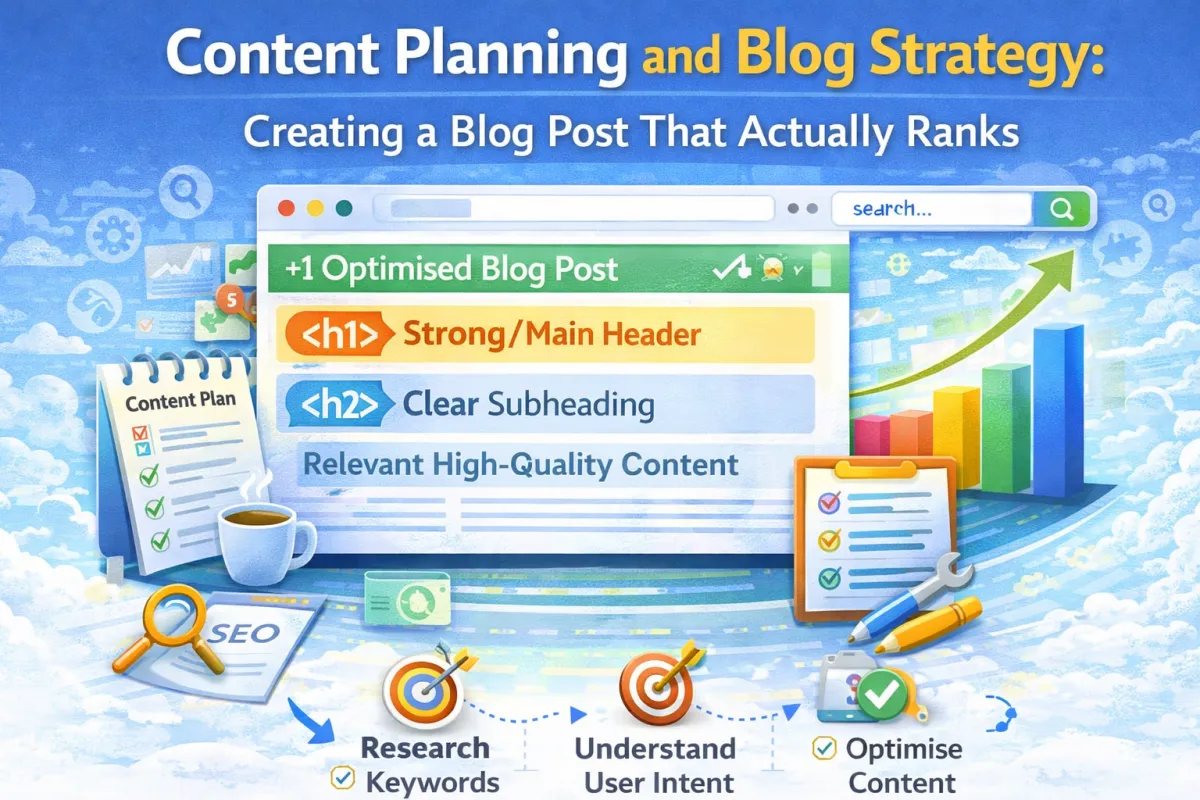
Content Planning and Blog Strategy: Creating a Blog That Actually Ranks
I watched a business owner spend six months writing blog posts. They wrote one about their industry. One about their process. One about common mistakes. One about trends.
All really well-written. All genuine. All pretty much ignored by Google.
Why? Because they weren't part of a strategy. They were just... blogs.
Here's the thing nobody tells you about blogging: publishing random content is like throwing spaghetti at the wall. Most of it sticks to nothing.
But when you plan your blog strategically? Everything changes. Your content ranks better. You get more traffic. Your audience actually finds you.
The difference isn't the quality of writing. It's the strategy behind it.
In this post, I'm going to show you exactly how to plan a blog that actually ranks and drives real business results.
Why Most Business Blogs Fail
Most small business blogs are terrible for SEO.
Not because the writing is bad. But because there's no strategy.
Here's what usually happens:
The Random Approach:
Post 1 (Week 1): "A Day in the Life of Our Team"
Post 2 (Week 3): "5 Tips from Our Industry"
Post 3 (Week 6): "Why We Love What We Do"
Post 4 (Week 10): "New Product Launch"
Post 5 (Never): "Common Mistakes People Make"
These posts are disconnected. They don't build on each other. They don't rank because they don't target anything specific. Google sees 5 random posts and thinks, "This business has no focus."
The Strategic Approach:
Core topic: "How to Maintain Your Boiler"
Post 1: "Complete Guide to Boiler Maintenance" (cornerstone)
Post 2: "Annual Boiler Servicing: Why It Matters"
Post 3: "5 Signs Your Boiler Needs Replacing"
Post 4: "Boiler Safety Tips for Winter"
Post 5: "Comparing Boiler Types: Which Is Best?"
These posts are connected. They support a central theme. They build authority on a specific topic. Google sees them as a cohesive cluster and ranks the whole thing better.
That's the difference between hoping your blog ranks and actually ranking your blog.
What Is Content Planning?
Content planning is the process of deciding what to write, when to write it, and why you're writing it.
It's not random. It's strategic.
Good content planning answers:
What topics does my audience search for?
Which topics align with my business goals?
How do these topics connect to each other?
Which topics have ranking potential?
How often should I publish?
What's my publishing schedule?
Without this, you're guessing. With it, you're executing a plan.
The Content Planning Process
Here's how to plan a blog that actually ranks:
Step 1: Define Your Core Topics (The Pillar Strategy)
Your blog should be built around core topics relevant to your business.
A local dentist, for example, might build their blog around five core topics: general dental health, cosmetic dentistry, emergency dental care, children's dentistry, and teeth whitening. Each of these becomes a "pillar" that everything else supports.
Similarly, a fitness studio might choose beginner fitness, weight loss, strength training, flexibility and yoga, and nutrition for fitness as their core pillars.
The key is choosing 4-6 topics that your ideal customers actually care about and that align with what your business offers. Each core topic becomes your "pillar." All other content supports this pillar.
Step 2: Research Keywords and Search Intent
Now that you have core topics, research what people actually search for within those topics.
There are plenty of free tools to help with this research. Google Autocomplete (which shows suggestions as you type), the "People Also Ask" section in search results, and Google Keyword Planner are all free and surprisingly effective. If you want more advanced features, tools like Ubersuggest have free versions, and SEMrush is available if you want to pay.
A plumber choosing "Emergency Plumbing" as a core topic might research what people actually search for: emergency plumber near me, burst pipe repair, how to stop a leak, when to call a plumber, and blocked drain emergency. These are real searches from real people—they're the foundation of your content plan.
Step 3: Create Content Clusters
A content cluster is a group of related posts that all link back to a "cornerstone" post.
Structure:
Cornerstone Post: "Complete Guide to Emergency Plumbing"
├─ Supporting Post: "How to Stop a Burst Pipe"
├─ Supporting Post: "Emergency Drain Cleaning: What to Know"
├─ Supporting Post: "When to Call an Emergency Plumber"
└─ Supporting Post: "Emergency Plumbing in Winter: Freezing Pipe Prevention"
The cornerstone is comprehensive (2000+ words). Supporting posts are more focused (1200-1500 words). Each supporting post links to the cornerstone. The cornerstone links to all supporting posts.
Why this works: Google sees all these posts as a connected cluster about emergency plumbing. The authority builds. The whole cluster ranks better.
Step 4: Build Your Editorial Calendar
An editorial calendar is your publishing schedule. It answers: What am I posting? When? Why?
Real example:
Month 1:
Week 1: Cornerstone post "Complete Guide to Emergency Plumbing"
Week 2: Supporting post "How to Stop a Burst Pipe"
Week 3: Supporting post "Emergency Drain Cleaning"
Week 4: Supporting post "When to Call an Emergency Plumber"
Month 2:
Week 1: New cluster on "Boiler Repairs" - Cornerstone post
Week 2: Supporting post "Signs Your Boiler Needs Repair"
Week 3: Supporting post "Boiler Safety Tips"
Week 4: Supporting post "Emergency Boiler Repair: What to Expect"
This is a plan. You know what's coming. You can batch-create content. You stay consistent.
Step 5: Decide on Publishing Frequency
How often should you publish?
The honest answer: Consistency matters more than frequency.
1 post per week is great if you can sustain it
2 posts per month is fine if that's sustainable
4 posts per month is better than 8 posts one month then nothing for three months
My recommendation: Start with 2 posts per month. That's sustainable for most businesses. Once you have 12 posts, consider increasing to 3-4.
Why frequency matters: Regular publishing signals to Google that your site is active. Sporadic posting suggests abandonment.
Step 6: Plan Your Clusters and Timeline
Map out your content clusters for the next 6-12 months.
Example: A Beauty Salon
Q1 (Months 1-3):
Cluster 1: Hair Care (Cornerstone + 4 supporting posts)
Cluster 2: Skincare (Cornerstone + 4 supporting posts)
Q2 (Months 4-6):
Cluster 3: Nail Care (Cornerstone + 4 supporting posts)
Cluster 4: Hair Color (Cornerstone + 4 supporting posts)
Q3 (Months 7-9):
Cluster 5: Wedding Hair & Makeup (Cornerstone + 4 supporting posts)
Cluster 6: Special Occasions (Cornerstone + 4 supporting posts)
This is your content strategy for the year. 18 posts total. All organized. All supporting your business goals.
Creating Your Content Calendar (Tool)
You don't need fancy software. A spreadsheet works perfectly.
Create columns for the essential information you need to track: post title, target keywords, which cluster the post belongs to, whether it's a cornerstone or supporting post, your word count target, publication date, current status (planned, writing, or published), which posts it should link to, and which posts should link to it.
For example, you might have an entry for a post titled "How to Fix a Leaky Tap" targeting the keywords "how to fix a leaky tap," part of your Plumbing Repairs cluster as a supporting post, with a 1200-word target, scheduled for January 15, currently in writing status, linking to your Plumbing Guide, and linked from your Emergency Plumbing post.
Simple. Clear. Keeps you organized.
Real-World Case Study
Let's look at how one business used strategic content planning to improve rankings.
The Business: A local dog grooming salon in Birmingham.
Before:
Posted randomly, whenever they felt like it
Average 2-3 posts per month
Posts were disconnected (one about pricing, one about their team, one about a new service)
Ranking for "dog grooming Birmingham": #15
Monthly organic traffic: 200 visitors
Organic enquiries: 1-2 per month
What They Did:
Identified core topics:
Dog grooming basics
Different coat types
Nail and paw care
Anxiety and handling difficult dogs
Seasonal grooming
Created content clusters:
Cluster 1: "The Complete Guide to Dog Grooming at Home"
Supporting: "How to Brush Your Dog's Coat"
Supporting: "Grooming Different Coat Types"
Supporting: "DIY Dog Bath: Step-by-Step"
Supporting: "Tools You Need for Home Grooming"
Cluster 2: "Professional Dog Grooming: What to Expect"
Supporting: "When to Take Your Dog to a Groomer"
Supporting: "How to Prepare Your Dog for the Salon"
Supporting: "Different Grooming Styles Explained"
Supporting: "Helping Anxious Dogs at the Groomer"
Built editorial calendar:
Months 1-3: Cluster 1 (cornerstone + 4 supporting posts)
Months 4-6: Cluster 2 (cornerstone + 4 supporting posts)
Months 7-12: Additional clusters
Published consistently:
2 posts per month, every month
Batched content creation (wrote all 8 posts for a cluster in one session)
Each supporting post linked to cornerstone
Cornerstone linked to all supporting posts
Maintained calendar:
Tracked what was published
Planned 6 months ahead
Updated calendar as they went
Results (12 months later):
Ranking for "dog grooming Birmingham" improved from #15 to #4
Monthly organic traffic: 200 → 1,240 visitors
Organic enquiries: 1-2/month → 8-12/month
Created 24 posts total (2 clusters with 4 supporting posts each = 10 posts per cluster, plus multiple additional clusters)
Posts now rank for 47 different keywords (up from 3)
They didn't hire an expensive agency. They just planned strategically and executed consistently.
Content Planning Best Practices
Here are the things that actually matter:
Write for Your Audience First. Your audience comes first. Google rewards content that serves people. Write helpful, genuine content that actually answers people's questions. This is more important than trying to game the algorithm.
Plan Clusters, Not Individual Posts. Don't plan 24 random posts. Plan 6 clusters of 4 posts each. The cluster structure is more powerful for rankings because it shows Google you have comprehensive coverage of a topic.
Batch Your Content Creation. Don't write one post per week spread out over the month. Write all 4 posts in a cluster in one session. It's more efficient. You stay consistent with voice and style. You can get in a flow state and be more productive.
Build Internal Links Into Your Plan. Before you write, know which posts will link to which. Plan this into your strategy. This ensures you're actually building the cluster structure you intended instead of creating disconnected posts.
Stick to Your Calendar. The biggest SEO mistake is inconsistency. Start small (2 posts/month) and stick to it. Small consistent effort beats sporadic large effort. Google rewards consistent publishers.
Update Old Content Regularly. Once you've published 6-12 posts, start updating old ones. Add new information. Add links to new posts. Refresh them quarterly. This keeps content fresh and gives old posts new ranking power.
Common Content Planning Mistakes
The biggest mistake businesses make: having no clear plan. They publish whenever they feel like it. No consistency. No strategy. Google sees randomness and doesn't prioritize the site. The fix is simple: create a 6-month content calendar before you start. Know what you're publishing and when.
Many businesses try to rank for everything. They write about 50 different topics hoping one sticks. But they have no authority in any area. Google sees scattered topics and isn't sure what the site is actually about. Instead, pick 5-6 core topics and build clusters around those. This creates depth.
Publishing inconsistently is another killer. You post 4 times one month, then nothing for two months. Google sees sporadic activity and doesn't prioritize your site because it signals abandonment. The fix is to commit to a sustainable schedule (2-3 posts/month) and stick to it religiously.
Not linking your content together is a missed opportunity. You write 24 posts but they're all separate islands. They don't link to each other. Google doesn't see them as connected. Instead, plan internal linking into your content clusters. The cornerstone post should link to supporting posts, and vice versa.
Finally, ignoring search intent wastes your time. You write posts about topics nobody's searching for. Or you write about topics people search for, but your angle doesn't match what they're looking for. The fix is to research what people actually search for and match their intent. If they're looking for "how to fix a leaky tap," write a how-to. Don't write about why taps are important.
FAQ
Q: How many posts should I have before I start seeing results? A: Most businesses see initial ranking improvements after 4-6 posts (1-2 clusters). Real, significant results usually take 12+ posts and 3-6 months.
Q: Should I publish all my content at once or spread it out? A: Spread it out. Consistency signals to Google that your site is active. Weekly or bi-weekly is ideal.
Q: How long should my blog posts be? A: Cornerstone posts: 2000+ words. Supporting posts: 1200-1500 words. Blog posts covering specific topics: 800-1200 words. Longer is fine if it adds value, but don't add fluff.
Q: Should I focus on quantity or quality? A: Quality. Always. One really helpful post beats 10 mediocre ones.
Q: Can I repurpose content from different platforms? A: Yes. A blog post can become social media posts, an email, a video script, etc. But each piece should stand alone as helpful content.
Q: How far ahead should I plan my content? A: At least 3 months, ideally 6 months. This keeps you from scrambling for content ideas and ensures consistency.
Q: Should I hire someone to write my blog posts? A: You can. Many businesses do. What matters is that posts are helpful, well-researched, and on-brand. Whether you write them or hire someone is less important.
Q: How do I decide which topics to write about? A: Research what your audience searches for. Look at your competitor's blogs. Ask your customers what questions they have. Use Google's "People Also Ask" section.
Q: Should I update old blog posts or write new ones? A: Do both. After 12 months, start a mix: 60% new posts, 40% updating old ones. Updating old posts is usually faster and can provide ranking boosts.
Q: What if I get off schedule? A: Don't stress. Life happens. Just get back on schedule. Consistency is about long-term patterns, not perfection.
Q: How do I measure if my content planning is working? A: Track: rankings, organic traffic, enquiries from organic search, keyword growth. Use Google Analytics and Google Search Console. Check after 6 months.
Q: Should all my posts target keywords? A: Most should, but not all. Some posts can target informational searches (building authority). Some can target commercial searches (driving enquiries). Mix them.
Q: How do I avoid running out of content ideas? A: Plan 6 months ahead using core topics and clusters. Use Google search to identify questions people ask. Ask your customers what they search for. Read competitor blogs.
The Bottom Line
Content planning is the difference between a blog that ranks and a blog that's just there.
You don't need fancy tools. You don't need to be a professional writer. You just need:
A clear plan (what topics, when, in what order)
Organized clusters (cornerstone posts + supporting posts)
Consistent publishing (2+ posts per month)
Strategic linking (posts linked to each other)
Long-term commitment (6-12 months minimum)
Do these five things, and your blog will rank. It's not complicated. It just requires planning and consistency.
Most businesses skip the planning and wonder why their blogs don't rank. Don't be that business.
Want help planning your blog strategy?
We'll help you identify core topics, create content clusters, and build an editorial calendar for the next 6-12 months. Most clients see ranking improvements within 2-3 months of consistent publishing following a strategic plan.
No more random posts. Just a clear strategy and consistent execution.
You can also get in touch directly if you'd prefer email or phone.