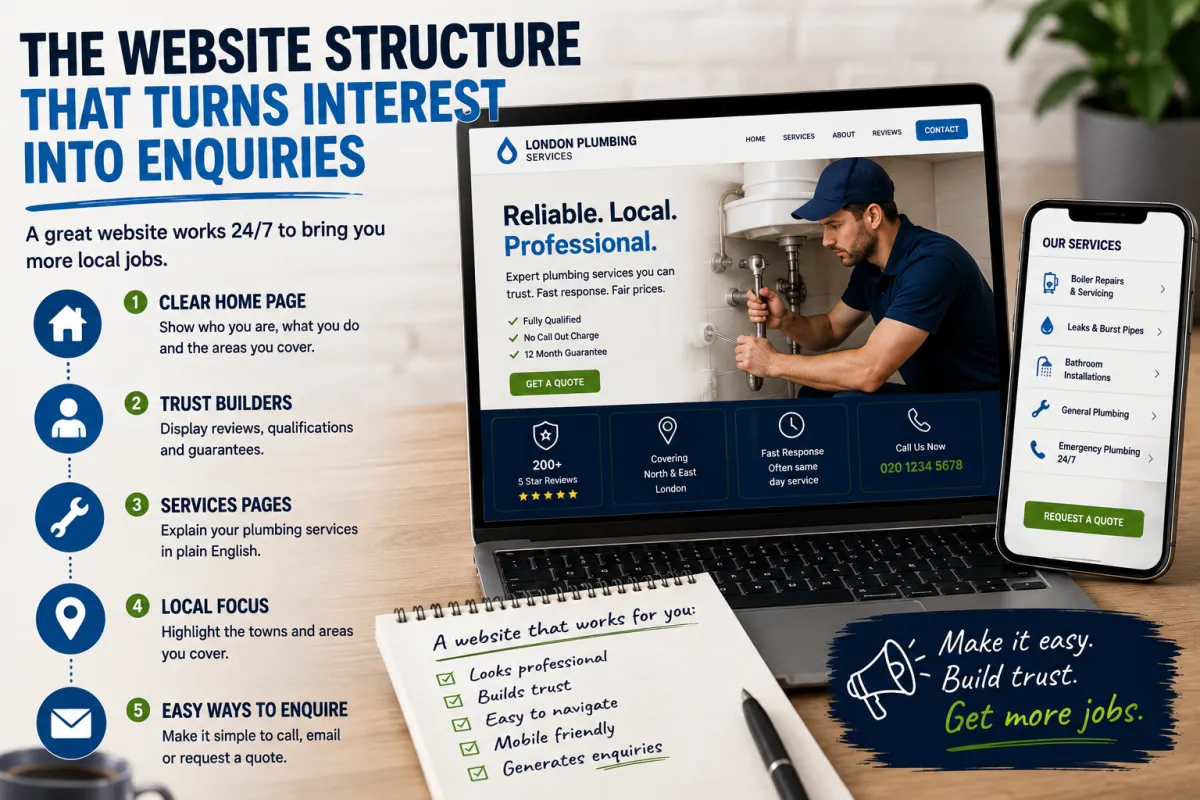
How to Build a Website for an Essex Plumbing Business
A plumbing website doesn’t need twenty pages, complicated animations or a video of water flowing over pebbles.
It needs to answer the right questions quickly.
What do you repair? Where do you work? Can the customer trust you? How can they contact you? What should they do next?
When those answers are easy to find, a simple website can produce more enquiries than an expensive site filled with vague promises.
THE HOME PAGE
The first screen should explain what the business does, its main location, the areas covered, the most important service and the quickest way to make contact.
A strong headline might read:
“Reliable Plumbing Services in Basildon and South Essex”
The supporting line could say:
“Plumbing repairs, leaks, toilets, taps, radiators and bathroom installations for homeowners, landlords and local businesses.”
Then provide clear actions such as:
Call 07XXX XXXXXX
Request a quotation
“Welcome to our website” wastes the most valuable space on the page.
THE SERVICES PAGE
A single services page can work for a smaller website when it contains useful detail.
Each service should explain the problem, common warning signs, what the plumber can do, any limits, who the service is for and how to enquire.
As the business grows, high-value or popular services can receive individual pages.
These may include emergency plumbing, leak detection and repairs, toilet repairs, tap and shower repairs, radiator installation, bathroom plumbing and landlord plumbing services.
Detailed explanations based on genuine experience are more useful than thin or copied service descriptions.
THE CONTACT PAGE
The contact page should include the telephone number, email address, form, working hours, emergency availability, base location, areas covered, expected response time and the information customers should send.
A manageable form may ask for name, postcode, telephone number, type of problem, preferred contact method and an optional photograph.
THE ABOUT SECTION
Customers aren’t looking for an autobiography. They want to know who they’re dealing with.
Useful details include the plumber’s name, experience, specialist work, qualifications, reason for starting the business, approach to customers’ homes and whether they work alone or with a team.
A real photograph can create more trust than several paragraphs of polished marketing language.
CLEAR CALLS TO ACTION
“Learn more” isn’t always useful.
Specific calls to action include:
Call about a plumbing emergency
Request a bathroom quotation
Send photographs of the problem
Check whether we cover your area
Book a plumbing repair
Ask about landlord maintenance
The right call to action depends on the service.
MOBILE USABILITY
Plumbing searches often happen while the customer is standing beside the problem.
Telephone numbers should be clickable. Text should be readable. Buttons should be easy to press. Pages should load quickly. Important information should appear early. Pop-ups shouldn’t cover the emergency number. Forms should remain short.
ESSEX SERVICE-AREA CONTENT
There are three useful levels of location content.
Level one is the main area. The home page identifies the business base and core service area.
Level two is an areas-covered section. This lists nearby towns and explains practical limits.
Level three is useful location pages. A separate town page is justified when the plumber genuinely serves the area and can add unique information.
That information might include services commonly provided there, example projects, typical response arrangements, reviews from the town, nearby districts and relevant property types.
Copying the same page and only changing the town name creates weak content.
REVIEWS AND PROOF
Proof works best close to the claim it supports.
Place an emergency repair review beside the emergency service section. Show completed bathroom work close to bathroom installation information. Add a landlord testimonial near landlord maintenance services.
This feels more convincing than placing every review on one separate page.
TRACKING REAL ENQUIRIES
A plumber should know whether the website produces worthwhile work.
Useful measures include telephone calls, forms, WhatsApp enquiries, quotation requests, services requested, customer locations and where the customer found the business.
The plumber doesn’t need a dashboard containing dozens of charts. They need to know whether the website generates useful enquiries.
WHAT THE WEBSITE DOESN’T NEED
A small plumbing business doesn’t automatically need dozens of pages, complicated animation, a customer login area, daily blog posts, an expensive custom booking system, generic stock photographs, long paragraphs filled with repeated search phrases or every social platform.
Start with a clear, credible website that works.
THE 99 QUID WEBSITES OFFER
At 99 Quid Websites, we build straightforward websites for small UK businesses and trades. A £99 website includes a home page, services page and contact page, giving a plumbing business the essential structure it needs to explain its work and receive enquiries.
We can build the pages around the plumbing work the business actually wants, the Essex areas it genuinely covers and the way customers prefer to make contact.
The result should feel like the plumber’s own business, not a generic trade template filled with meaningless wording.
YOUR PLUMBING WORK DESERVES A WEBSITE THAT WORKS JUST AS HARD
You already know how to solve the customer’s plumbing problem. Your website’s job is to make sure they find you, trust you and make contact.
When the current website is old, unclear or missing entirely, speak to 99 Quid Websites about a simple new site built for the plumbing business.
FREQUENTLY ASKED QUESTIONS
How many pages does a plumber’s website need?
A small plumbing business can begin with a strong home page, services page and contact page. Additional pages can be added later for important services or locations.
How much should a plumbing website cost?
Prices vary depending on pages, copywriting, photography, booking tools and support. The key question is whether the website represents the business clearly and produces worthwhile enquiries.
Does a plumber need separate pages for every service?
No. A detailed services page may be enough initially. Separate pages become useful for important services that customers search for frequently or that the plumber particularly wants to promote.
Can a new plumbing website appear on Google?
A new website can be indexed and appear in search results. Strong local visibility takes ongoing work, including clear service content, accurate business information, reviews and a properly managed Google Business Profile.
Should a plumber include an online booking system?
It depends on how the business works. Planned servicing and quotations may suit online booking. Emergency problems often need a telephone call or message first.
Can a plumbing website target several Essex towns?
Yes, where the business genuinely serves those places. The website should state a realistic service area and provide useful, original local information.
How quickly can a simple plumbing website be built?
That depends on how quickly the plumber supplies services, coverage, contact details, credentials, reviews and photographs. A straightforward three-page website is faster to prepare than a large custom build.