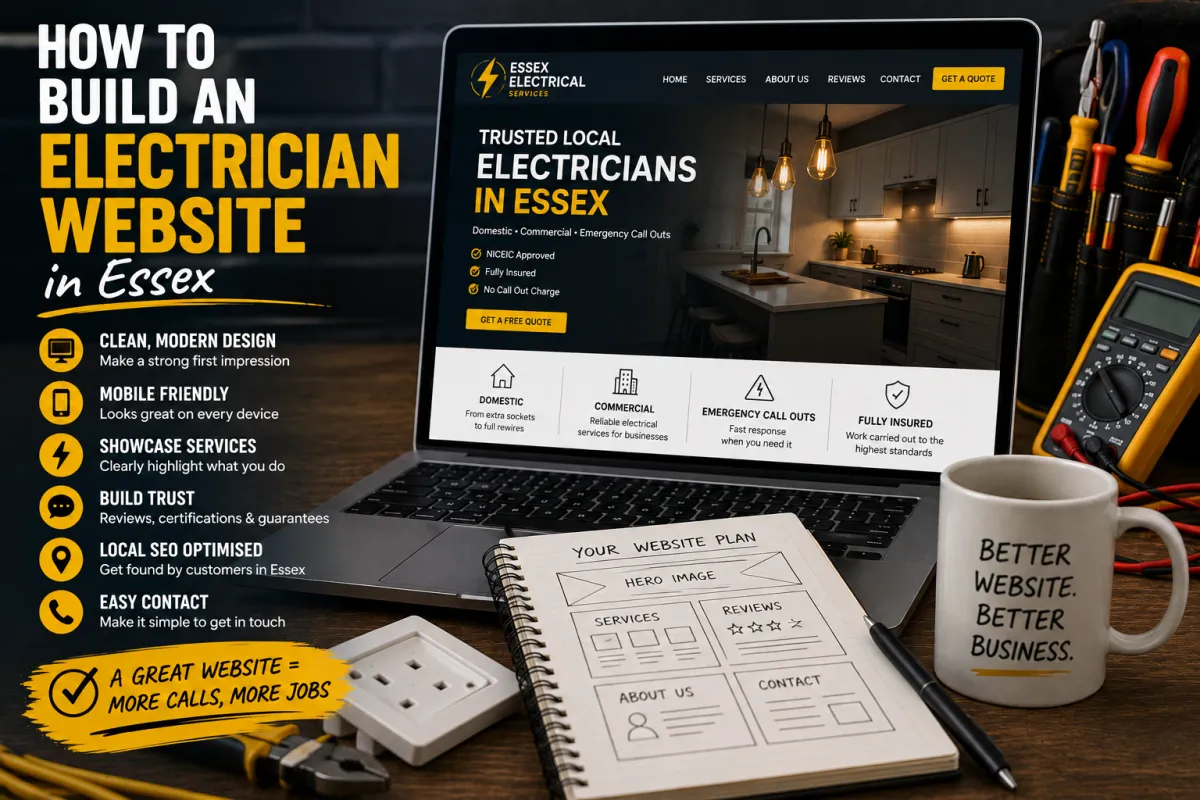
How to Build an Electrician Website in Essex
A small electrical business doesn’t need a website filled with moving graphics, technical diagrams and photographs of light bulbs.
It needs to answer practical questions.
What work do you provide?
Which parts of Essex do you cover?
Are you registered?
Can you handle this type of property?
What happens after someone contacts you?
Will the work be tested and certified?
How can the customer request a quotation?
A simple website can answer all of these.
The quality comes from the information, structure and proof.
START WITH THE THREE ESSENTIAL PAGES
A new electrician website can begin with:
A home page
A services page
A contact page
This is enough to establish the business online, provided each page has a clear job.
As the website grows, important services can receive separate pages.
The first version should still be complete. A small website doesn’t need to feel unfinished.
WHAT THE HOME PAGE NEEDS TO DO
The home page has several seconds to reassure the visitor that they’ve found the right electrician.
The top of the page should show the main service, base location, realistic area covered, a trust signal, telephone number and quotation button.
A strong opening might read:
REGISTERED ELECTRICIAN IN CHELMSFORD AND MID ESSEX
Domestic electrical repairs, consumer unit upgrades, rewires, EICRs and EV charger installations for homeowners, landlords and local businesses.
Then provide two clear actions:
Call about an electrical fault
Request a written quotation
This immediately answers the visitor’s main questions.
“Welcome to our website” adds nothing.
“We provide high-quality electrical solutions” remains too vague.
Specific services and locations work harder.
PUT URGENT AND PLANNED CUSTOMERS ON SEPARATE PATHS
An electrical emergency visitor behaves differently from someone planning a rewire.
The home page should recognise both.
An urgent section might say:
HAVE YOU LOST POWER OR FOUND AN ELECTRICAL FAULT?
Call us with your postcode and a brief description of the problem. Tell us immediately when there is heat, smoke, a burning smell or visible damage.
A planned work section might say:
PLANNING ELECTRICAL IMPROVEMENTS?
Request a quotation for additional sockets, lighting, consumer unit upgrades, rewires, landlord inspections or EV charging.
This reduces confusion and helps the customer choose the right action.
USE THE HOME PAGE TO ESTABLISH TRUST
Near the opening section, include concise proof:
Registered with NAPIT
Public liability insured
Electrical certification provided
Based in Chelmsford
Domestic and landlord work
Established in 2018
Only include claims that are correct.
Registration details should lead to a page where the customer can verify the business.
Electrical Safety First recommends registered electricians because they work to BS 7671, undergo assessment, carry insurance and provide certification.
Source: https://www.electricalsafetyfirst.org.uk/find-a-registered-electrician/
That makes registration information one of the most valuable elements on the page.
STRUCTURE THE SERVICES PAGE AROUND CUSTOMER INTENT
A services page shouldn’t be a dense list of fifty tasks.
Group work into recognisable customer needs.
ELECTRICAL REPAIRS AND FAULT FINDING
Explain the types of fault handled:
Tripping circuits
Loss of power
Damaged sockets
Lighting faults
Burning smells
Faulty switches
Intermittent electrical problems
Outdoor electrical faults
Tell the customer what information to provide and whether emergency appointments are available.
CONSUMER UNIT UPGRADES
Explain why customers enquire, how the existing installation is assessed, what testing is required and which certificates follow.
Avoid scare tactics.
The page can say:
An older consumer unit doesn’t automatically mean the whole property requires rewiring. We assess the unit, earthing, bonding and existing circuits before recommending work.
That sounds measured and trustworthy.
REWIRES
Include full and partial rewires, renovation work, extensions and occupied properties.
Explain survey and quotation, cable routes, first and second fix, coordination with other trades, power interruptions, testing, certification, making good and approximate project stages.
This is a major buying decision. Give it enough space.
EICRS AND LANDLORD ELECTRICAL WORK
Describe the inspection, report, codes, remedial process and document turnaround.
Include service options for homeowners, buyers, landlords, letting agents, HMOs, commercial premises where offered and social housing providers where capacity permits.
Landlord regulations require electrical installations to be inspected and tested at least every five years, with reports and required remedial work handled within statutory timeframes.
A clear page can attract customers who need reliable compliance support.
EV CHARGER INSTALLATION
Explain the assessment process.
Mention off-street parking, consumer unit suitability, supply capacity, cable route, charger position, load management, connectivity, testing, certification, charger brands and the customer-supplied equipment policy.
The page should avoid promising an instant fixed price without enough information.
An enquiry form can request photographs of the consumer unit, meter position, proposed charger location and cable route.
LIGHTING, SOCKETS AND HOME IMPROVEMENTS
Smaller work deserves clear treatment too.
This section may include additional sockets, USB sockets, indoor lighting, garden lighting, security lighting, electric showers, extractor fans, smoke alarms, smart controls, kitchen and bathroom electrics and outbuildings and garages.
Customers often search for the task they need, not “domestic electrical services”.
Use familiar language.
EXPAND HIGH-VALUE SERVICES INTO SEPARATE PAGES
A three-page website can present every service on one organised page.
As the business grows, create individual pages for work that receives regular searches, generates strong revenue, needs detailed explanation, has a distinct customer type or produces useful project examples.
A growing electrician site might eventually include emergency electrician, consumer unit upgrades, house rewiring, EICRs, landlord electrical services, EV charger installation, domestic electrical work, commercial electrical services, service areas, projects, about and contact.
Each page should contain original information.
Copying one page and swapping “Chelmsford” for “Basildon” produces thin, repetitive content.
GIVE EVERY SERVICE PAGE A CLEAR STRUCTURE
A useful service page can follow this order.
START WITH THE CUSTOMER’S PROBLEM
Your circuits keep tripping, sockets feel warm or part of the house has lost power.
This immediately shows relevance.
EXPLAIN THE SERVICE
We carry out electrical fault finding across Chelmsford and nearby areas, testing the affected circuit to identify the cause and recommend safe repairs.
DESCRIBE THE PROCESS
We begin by discussing the fault and checking for immediate risks. At the property, we inspect and test the relevant parts of the installation. We’ll explain our findings before carrying out additional chargeable work.
SHOW PROOF
Include a relevant review or project.
ANSWER COMMON QUESTIONS
Cover price, timescale, access, disruption and certification.
FINISH WITH A SPECIFIC ACTION
Call about an electrical fault.
A generic “Contact us today” feels weaker.
BUILD A STRONG CONTACT PAGE
The contact page should make enquiring simple.
Include business telephone number, email address, enquiry form, base town, areas covered, normal working hours, emergency availability, expected response time, company registration details where relevant and instructions for sending photographs.
A useful introduction might say:
Tell us what electrical work you need, your postcode and your preferred timescale. For consumer unit, EV charger and fault enquiries, photographs can help us understand the installation before arranging a visit.
This improves the first conversation.
USE A SERVICE SELECTOR ON THE FORM
A dropdown or set of choices can ask:
What do you need help with?
Electrical fault
Consumer unit
EICR
Rewire
EV charger
Lighting or sockets
Landlord work
Commercial work
Something else
The next questions can remain simple:
Name
Telephone number
Postcode
Property type
Brief description
Preferred timescale
Photograph upload
Avoid requiring account creation.
Avoid asking for information the electrician won’t use.
WRITE AN ABOUT PAGE PEOPLE CAN BELIEVE
Customers often prefer local electrical businesses because they know who is responsible for the work.
Use that advantage.
The about page can introduce the owner, team, years in the trade, registration, specialisms, typical customers, main service area, working approach and company history.
A natural opening might be:
I’m James, a registered electrician based in Wickford. I work with homeowners, landlords and small businesses across South Essex, specialising in fault finding, consumer unit upgrades, EICRs and renovation projects.
That feels more credible than:
We are a leading provider of innovative electrical solutions.
A sole trader can use “I”.
There is no need to pretend the business has departments, fleets and account managers.
SHOW THE PERSON BEHIND THE BUSINESS
Use a clear, recent photograph.
The electrician could appear beside the branded van, wearing normal work clothing, holding testing equipment, at a completed project or inside a tidy working environment.
Avoid heavily staged stock photographs.
Customers want to recognise the person arriving at their property.
Team photographs should include names and roles where appropriate.
TURN PROJECTS INTO SMALL CASE STUDIES
A project gallery can provide powerful search and conversion content.
Each project should answer:
What did the customer need?
Where was the property?
What challenges were involved?
What work was completed?
How was disruption managed?
What documentation was provided?
What was the result?
For example:
CONSUMER UNIT UPGRADE BEFORE AN EV CHARGER INSTALLATION IN BRENTWOOD
The homeowner contacted us after ordering an electric vehicle and wanted to know whether the existing installation could support a home charger. We assessed the supply, consumer unit, earthing and proposed cable route. The existing unit was upgraded, circuits were tested and labelled, and a dedicated supply was installed for the charger. The customer received the relevant electrical certification after completion.
This single case study supports several services: consumer unit upgrades, EV chargers, testing, certification and Brentwood location searches.
Real work gives the website authority.
CREATE USEFUL ESSEX LOCATION CONTENT
An Essex electrician usually benefits from a focused geographical structure.
The home page should identify the main base.
The contact page should list the realistic service area.
Separate location pages can be added when there is enough genuine material.
A useful Chelmsford page might include services provided locally, nearby districts covered, examples of Chelmsford work, reviews from local customers, typical travel arrangements, parking or access considerations and links to relevant service pages.
A useful Basildon page would contain different projects, locations and customer details.
Every location page should earn its place.
Avoid paragraphs that repeat a town name unnaturally:
Our Basildon electricians provide electrician services in Basildon for Basildon customers seeking a Basildon electrician.
That reads poorly and weakens trust.
Write for the customer.
MATCH SERVICE AREAS TO JOB VALUES
Your website can describe different coverage for different work.
For example:
We provide repairs, sockets, lighting and fault finding throughout Chelmsford and nearby villages. For rewires, landlord portfolios and commercial projects, we cover wider parts of Essex.
This reflects how trade businesses operate.
It also prevents a customer 45 miles away requesting a low-value appointment because the home page claimed to cover the whole county.
EXPLAIN PRICING WITHOUT TRAPPING THE BUSINESS
Electrical work varies.
Publishing a fixed price for every job can cause problems when access, existing faults or materials differ.
Customers still want an idea of how charges work.
The website could explain call-out or initial attendance charges, minimum labour charges, whether quotations are free, whether diagnostic work is chargeable, what written quotes include, how additional work is approved, deposit requirements, VAT status and payment methods.
For example:
Fault-finding appointments are charged for the electrician’s time because testing is required to locate the problem. Where further repairs are needed, we’ll explain the options and costs before continuing.
This filters out people expecting a free diagnostic visit.
USE CALLS TO ACTION THAT MATCH THE JOB
Different pages should offer different next steps.
On an emergency page:
Call about an urgent electrical fault
On an EICR page:
Request an EICR quotation
On a rewire page:
Arrange a property survey
On an EV page:
Check your home’s charger requirements
On a landlord page:
Discuss your rental property or portfolio
On a general service page:
Tell us what electrical work you need
Specific buttons help customers act.
MAKE THE WEBSITE WORK PROPERLY ON A PHONE
Many customers will open the site on a mobile.
The phone version needs clickable telephone numbers, large buttons, readable text, short paragraphs, clear headings, fast-loading photographs, forms that work on a small screen, contact details near the top, no pop-up covering the call button and no tiny menu links.
An urgent customer may be standing in a dark hallway using mobile data.
The website should remain usable under those conditions.
CONNECT THE WEBSITE TO GOOGLE BUSINESS PROFILE
The information on the website and Google Business Profile should match.
Use the same business name, telephone number, website address, main service categories, working hours, service area and business description.
Add genuine project photographs and request reviews consistently.
The website provides detail. The Google profile helps local customers discover the business and make contact.
Together, they create a stronger local presence.
COLLECT BETTER REVIEWS
After completing a job, make the review request specific.
Instead of:
Please leave us a review.
Try:
Thank you for choosing us for your consumer unit upgrade. A short review mentioning the work, your area and how you found the service would really help other local customers.
This encourages useful detail without dictating what the customer must say.
The best reviews often mention service, town, communication, punctuality, tidiness, final price, problem solved, certification and recommendation.
Place them on the relevant page.
ADD FAQS BASED ON REAL CONVERSATIONS
Electricians answer the same questions repeatedly.
Those questions belong on the website.
Examples include:
How long does an EICR take?
Will an EICR leave us without power?
Does an old fuse box mean we need a rewire?
Can we stay in the house during rewiring?
Do you make good after chasing walls?
Can you install a charger we’ve already bought?
Will we receive a certificate?
Do you work with letting agents?
Do you cover our village?
Can you provide a written quotation?
FAQs help customers and reduce repetitive enquiries.
The answers should be careful and accurate. Avoid giving technical instructions that encourage unsafe DIY electrical work.
WRITE FOR PEOPLE WHO AREN’T ELECTRICIANS
Customers may not understand RCBO, RCD, SPD, Ze readings, bonding, radial circuits, ring finals, distribution boards, ADS, BS 7671 or notifiable work.
Technical terms are sometimes necessary.
Explain them when they appear.
For example:
An RCD is a protective device designed to disconnect the electricity quickly when certain faults are detected.
The website’s job is to make the service understandable.
It isn’t an exam paper.
KEEP LEGAL AND REGISTRATION DETAILS CURRENT
Electrical standards, regulations and registration details can change.
Review pages that mention Building Regulations, landlord responsibilities, Wiring Regulations, government grants, EV charger requirements, registration status, certificates and scheme logos.
The 2025 extension of electrical safety standards to social rented homes shows why older website copy can become inaccurate.
Where the website discusses legal duties, link to a current official source and avoid presenting general content as individual legal advice.
TRACK THE ENQUIRIES THAT MATTER
Useful website tracking should answer:
Which service page produced the enquiry?
Which town did the customer come from?
Did they call, email or use the form?
Was the enquiry suitable?
Did it become a survey or quotation?
Was the quote accepted?
What type of work generated the best return?
This helps the electrician decide what to improve.
A website producing four rewire surveys may be more valuable than one producing fifty unrelated visits.
Measure outcomes.
REVIEW THE SITE EVERY THREE MONTHS
A quarterly website review can take less than an hour.
Check contact details, service area, working hours, registration information, forms, telephone buttons, recent reviews, project photographs, prices or charges, services no longer offered and new work to promote.
Add one recent project.
Replace an outdated photograph.
Answer a new customer question.
Small updates keep the site credible.
WHAT A SMALL ELECTRICIAN WEBSITE CAN LEAVE OUT
A local electrician rarely needs a complicated customer portal, dozens of stock photographs, background videos, daily blog posts, long company mission statements, animations on every section, twenty social media links, a nationwide location list, technical content copied from manufacturers or pages created only to repeat town names.
A clear three-page website can perform well when the content reflects the real business.
Start with what customers need.
Expand when there is a commercial reason.
HOW 99 QUID WEBSITES CAN HELP
At 99 Quid Websites, we build straightforward websites for UK small businesses and trades.
The £99 website package includes a home page, services page and contact page.
Managed hosting is £50 per month.
For an electrician, those pages can be structured around your genuine services, registration and qualifications, the Essex areas you cover, the work you want more of, your preferred enquiry process, customer reviews and project photographs.
The wording should sound like your business.
A sole trader in Wickford needs a different website from a commercial contractor covering Essex and East London.
An electrician focusing on landlord EICRs needs different content from one building an EV charger and home electrification service.
The website should reflect that.
YOUR ELECTRICAL WORK DESERVES CLEARER MARKETING
You already understand testing, installation and safety.
Your customers usually won’t.
They need a website that explains the work without overwhelming them. They need proof that the business is genuine, registered and organised. They need a simple way to make contact.
When your current site is outdated, unclear or missing entirely, it becomes harder for the right customer to choose you.
A well-built electrician website can help turn local searches into suitable enquiries, written quotations and booked work.
FREQUENTLY ASKED QUESTIONS
How many pages does an electrician website need?
A small electrical business can begin with a home page, services page and contact page. Additional pages can later target services such as rewires, EICRs, consumer unit upgrades, EV chargers and emergency work.
Should every electrical service have a separate page?
No. Begin by grouping services clearly. Create separate pages for work that generates regular searches, produces valuable enquiries or needs detailed explanation.
Can a three-page electrician website rank on Google?
A three-page website can appear in search results when it contains clear, original and locally relevant information. Competitive rankings usually require ongoing work, strong local signals, reviews, useful service content and a properly managed Google Business Profile.
Should electrician websites display prices?
Publishing call-out charges, minimum charges or guide prices can help qualify customers. Complex work often needs a survey or testing before an accurate quotation can be provided.
What photographs should an electrician use?
Use genuine photographs of the electrician, van, consumer units, rewires, EV chargers, testing, lighting, commercial work and completed projects. Remove customer details and sensitive property information before publishing.
Does an electrician need an online booking system?
Many businesses can manage with a clear enquiry form and telephone number. Fixed inspection appointments may suit online booking, while faults and installation projects often need a conversation first.
Should an electrician include registration badges?
Yes, where the business genuinely holds the registration and follows the scheme’s branding rules. Include enough information for customers to verify the registration.
How should an electrician target several Essex towns?
State the main base and realistic coverage clearly. Add individual town pages only when each contains useful local information, projects, reviews and genuine service detail.