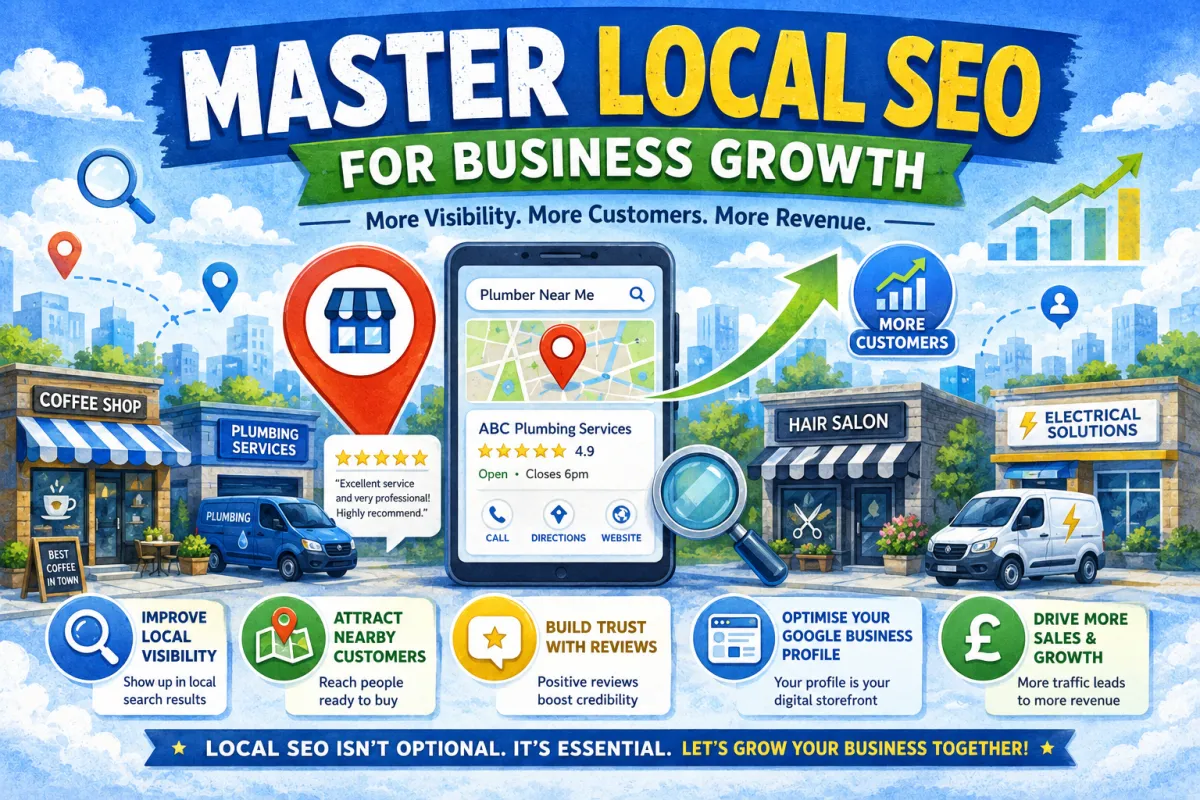
Master Local SEO for Business Growth
Local SEO, Digital Marketing, Small Business Growth, Trades, Service Businesses
How Local‑Focused Websites Are Nailing It Online (And What Local Businesses Can Learn)
Local‑focused websites are quietly dominating search results, winning the clicks, calls, and customers that many broader, “catch‑all” sites miss. For trades and service‑based businesses, understanding how these hyper‑local sites work is the key to unlocking serious, sustainable search traffic and real‑world revenue.
Why Local‑Focused Websites Are Winning in Search Right Now
Search behaviour has changed. People rarely just search for “plumber” or “accountant” anymore. They search for “plumber in Shoreditch”, “accountant in Manchester city centre”, or “best coffee near me”. Google’s algorithms have followed that behaviour, heavily rewarding pages that clearly serve a specific local intent.
Local‑focused websites are nailing it online because they do one thing exceptionally well: they make it obvious to both users and search engines that they are the most relevant answer for a particular service in a particular area. They don’t try to be everything to everyone. Instead, they dominate narrow, clearly defined local niches and stack dozens or hundreds of these small wins into serious traffic and leads.
The Power of Hyper‑Local Focus: From “Nationwide” to “Local Town”
Many business websites still take a broad approach: generic service pages, a single “Areas We Cover” section, and a hope that Google will somehow connect the dots. Local‑focused sites flip this model. They build out dedicated pages for specific towns, districts, and even local towns, each optimised around how people actually search in that area.
Instead of: “Plumbing Services” with a list of cities in a paragraph
They create: “Emergency Plumber in Camden”, “Boiler Repair in Islington”, “Bathroom Fitter in Hackney” – each with tailored content, FAQs, and local proof.
For Google, this is crystal clear: each page serves a focused search intent tied to a specific location. For users, it feels personal and relevant – they see their town name, local landmarks, and real customers from their area. That combination is why these sites outperform broader competitors that rely on thin, generic content.
💡 Pro Tip for Local Businesses: Think in terms of searchable locations, not just service areas. If locals identify as living in a particular town, village, borough, or local town, it probably deserves its own optimised page.
What Local‑Focused Websites Do Differently (And Better)
1. They Build Deep, Not Just Wide
Local winners don’t just spin up hundreds of near‑duplicate location pages. They invest in depth. A strong local page typically includes:
A clear, benefit‑driven headline with the service and location (e.g., “Reliable Garden Maintenance in Bristol BS3 & BS4”)
Service descriptions tailored to local needs or property types in that area
Local testimonials, case studies, or photos from that specific town or district
References to well‑known landmarks, postcodes, or local town names to reinforce relevance
Practical details: response times, call‑out fees, and availability specific to that area
This depth signals to Google that the page isn’t just a template swap; it’s genuinely useful and unique. That’s increasingly important as search engines crack down on thin, duplicate location content.
2. They Speak the Local Language (Literally and Figuratively)
Local‑focused sites mirror how people in that area actually talk. That might mean including local slang, place nicknames, or specific building types (“Victorian terraces in Jesmond”, “new‑build estates in Milton Keynes”). It also means using the exact phrases people type into search, such as:
“24‑hour locksmith in Leeds LS1”
“family‑friendly restaurant in Cheltenham town centre”
“SEO help for small businesses in Brighton”
By aligning content with real queries, these sites capture not just generic traffic, but high‑intent local searchers who are ready to call, book, or buy.
3. They Combine Local SEO With Real‑World Trust Signals
Ranking is only half the battle; conversion is where the money is made. Local‑focused websites pack their pages with trust signals that matter locally:
Google reviews from customers in that specific area, often embedded or quoted on the page
Memberships in local business associations, chambers of commerce, or trade bodies
Photos of the team working on recognisable local streets or buildings
Locally relevant guarantees (“on‑site in 60 minutes anywhere in Reading”)
These elements reassure visitors that they’re dealing with a real, nearby business that understands their context – not a faceless national brand or lead‑gen middleman.

Businesses that map services to specific local towns consistently see higher‑intent local traffic.
How Focusing on Local Areas Supercharges Search Traffic
For local businesses, the real magic of local‑focused websites lies in how they turn small, specific searches into a big traffic engine. Instead of fighting for ultra‑competitive national keywords, they target dozens or hundreds of easier, location‑qualified phrases like “roof repair in Stockport” or “yoga classes in Hove”.
The Long‑Tail Local Effect
Individually, a keyword like “emergency electrician in Putney” might only get a modest number of searches per month. But if your site targets:
20+ local towns in one city,
across 5–10 core services,
you’re suddenly looking at hundreds of targeted phrases – each with lower competition and higher buying intent than their broad equivalents. Collectively, they add up to a powerful local traffic stream that competitors often overlook because they’re fixated on “big” keywords.
📌 Key Takeaway for Local Businesses: You don’t need to rank #1 for “plumber UK” to grow. You need to rank consistently for the specific local searches your best customers are actually making.
Stronger Relevance, Higher Click‑Through Rates
When a user sees their exact town or postcode in a title tag and meta description, they’re far more likely to click. A result that reads:
“24/7 Emergency Locksmith in Guildford – On‑Site in 30 Minutes”
will almost always beat a generic:
“UK Locksmith Services – Fast & Reliable”
even if the generic site has a bigger brand. That higher click‑through rate (CTR) is a positive signal back to Google, which can further reinforce rankings over time.
Local Intent Means Local Conversions
Local searchers tend to be closer to taking action. Someone searching “website design company near Birmingham New Street” isn’t just browsing; they’re likely ready to book a consultation. That’s why local‑focused websites often see:
Higher call and form‑fill rates than broad traffic
Shorter sales cycles (people already know what they want and where)
Better customer fit, as visitors self‑select by location
For owners and managers, this makes local SEO a particularly attractive channel: it’s easier to tie rankings directly to leads and revenue, not just “traffic”.
A Practical Blueprint for Businesses: Turning Your Site into a Local Powerhouse
Step 1: Map Your Real‑World Service Areas
Start with a simple exercise: list the towns, districts, and local towns where you actually want customers. Not just where you could go, but where it makes commercial sense based on travel time, margins, or logistics. Group them into logical clusters – city, region, or radius from your base.
This list becomes the foundation of your local content plan. Each high‑priority area should eventually have its own tailored page or section on your site.
Step 2: Build or Improve Location‑Specific Pages
For each priority area, create a page that answers a simple question: “Why are we the best choice for this service in this place?” Structure might look like:
Intro: who you are and what you do, explicitly tied to the location
Services: how your core offerings apply to common local scenarios (property types, industries, typical problems)
Proof: local reviews, mini case studies, or “areas we’ve recently worked in” lists
Practical info: response times, opening hours, parking or access notes if you have a physical location
Strong local call‑to‑action: “Call our [Town] team today” or “Book a free visit in [Area]”
Avoid copy‑and‑paste. While you can reuse structure, the wording, examples, and proof should feel genuinely tailored to each area. This is where local‑focused sites really pull ahead.
Step 3: Optimise On‑Page Elements for Local Search
Once you have strong content, make it easy for search engines to understand the local relevance. For each page, pay attention to:
Title tag: include service + main location (and optionally a key benefit)
Meta description: reinforce location and highlight what makes you different locally
Headings (H1, H2): naturally include town, area names, or postcodes where appropriate
Internal links: connect related local pages and your main service pages to share authority
This isn’t about keyword stuffing; it’s about making sure the page clearly reflects how a real person would search for your service in that location.
Step 4: Align Your Google Business Profile and Citations
Local‑focused websites perform even better when they’re supported by a consistent Google Business Profile (GBP) and local citations (directory listings). Make sure:
Your business name, address, and phone number (NAP) are consistent across your site, GBP, and major directories
Your GBP links to a relevant local page, not just your homepage (especially for multi‑location businesses)
You actively collect and respond to reviews, ideally mentioning locations naturally in your replies
Together, your website and GBP send a strong, consistent signal about where you operate and who you serve, improving your chances of appearing in both the map pack and organic results.
How Local Focus Becomes a Scalable Growth Strategy
Local‑focused websites present a huge opportunity for trades and service‑based businesses that want measurable results. Local SEO is one of the most trackable, ROI‑driven channels you can invest in, because you can clearly see which areas and services are driving calls and enquiries.
Design Local Content Frameworks You Can Reuse
High‑performing businesses create modular templates for local pages – structures that can be adapted to different areas without becoming duplicate content. A framework might define:
Recommended word counts and section order for each type of local page
Where to include testimonials, FAQs, and local proof elements
Guidelines for weaving in local keywords and landmarks naturally
With a strong framework, your team can roll out high‑quality local pages over time, while still customising each one enough to satisfy both users and search engines.
Use Local Data to Make Smarter Decisions
Instead of guessing where to focus, use specific local opportunity data to guide your efforts. For example:
Search volume for “[service] in [your town]” and surrounding areas
A quick check showing where competitors have local pages and you do not
Simple before‑and‑after metrics for each new local page you launch
This helps you see where there’s real money left on the table in specific areas, rather than spreading your efforts too thin.
Track What Local‑Focused Businesses Actually Care About
Local businesses – from trades to clinics to multi‑location retailers – care less about impressions and more about calls, bookings, and visits. When you review your local strategy, focus on:
Rankings and traffic for priority location pages, not just the homepage
Phone calls and form submissions by location (where tracking allows)
Google Business Profile performance in target areas (map pack visibility, direction requests, click‑to‑call)
This kind of granular view makes your marketing efforts tangible and makes it easier to justify ongoing investment in expanding local coverage.
Common Mistakes That Hold Local‑Focused Strategies Back
Not every attempt at local focus succeeds. Businesses often fall into the same traps – and those who avoid them are the ones truly nailing it online. Watch out for:
Thin, near‑duplicate location pages: Swapping town names in otherwise identical content is a fast track to poor engagement and weak rankings.
Ignoring real‑world service boundaries: Targeting areas you can’t realistically serve leads to bad reviews and wasted leads.
Over‑optimising with awkward keyword stuffing: Pages should read naturally to local humans first, algorithms second.
Neglecting mobile experience: Most local searches happen on phones. Slow, clunky mobile pages kill conversions even if rankings are strong.
💡 Pro Tip for Local Businesses: Before launching a new local page, ask: “Would I be happy to land on this if I lived in this area and needed this service today?” If the answer is anything but “yes”, improve it.
Bringing It All Together: Local Focus as a Competitive Advantage
Local‑focused websites are thriving online because they align perfectly with how people search and buy today. They:
Target specific local areas where intent – and conversion potential – is highest
Provide rich, locally relevant content that feels genuinely useful to residents and nearby businesses
Combine SEO best practices with real‑world trust signals to turn clicks into calls, bookings, and sales
For local businesses, embracing this approach means moving beyond a generic brochure website and building a digital presence that mirrors how you operate on the ground.
You don’t need to outspend national brands or chase every keyword under the sun. You need to own your local patch online: street by street, town by town, service by service. That’s exactly what the best local‑focused websites are doing – and why they’re quietly, consistently nailing it online.
Next steps: Choose three high‑value locations today. Audit your existing presence for each one, then plan or upgrade a dedicated local page that truly deserves to rank. Repeat that process over the coming months, and you’ll build a local search footprint that competitors will struggle to catch.
Need help implementing this? If you’d like expert support building or improving your local‑focused website and SEO strategy, get in touch with us via our contact page and we’ll walk you through the next steps.