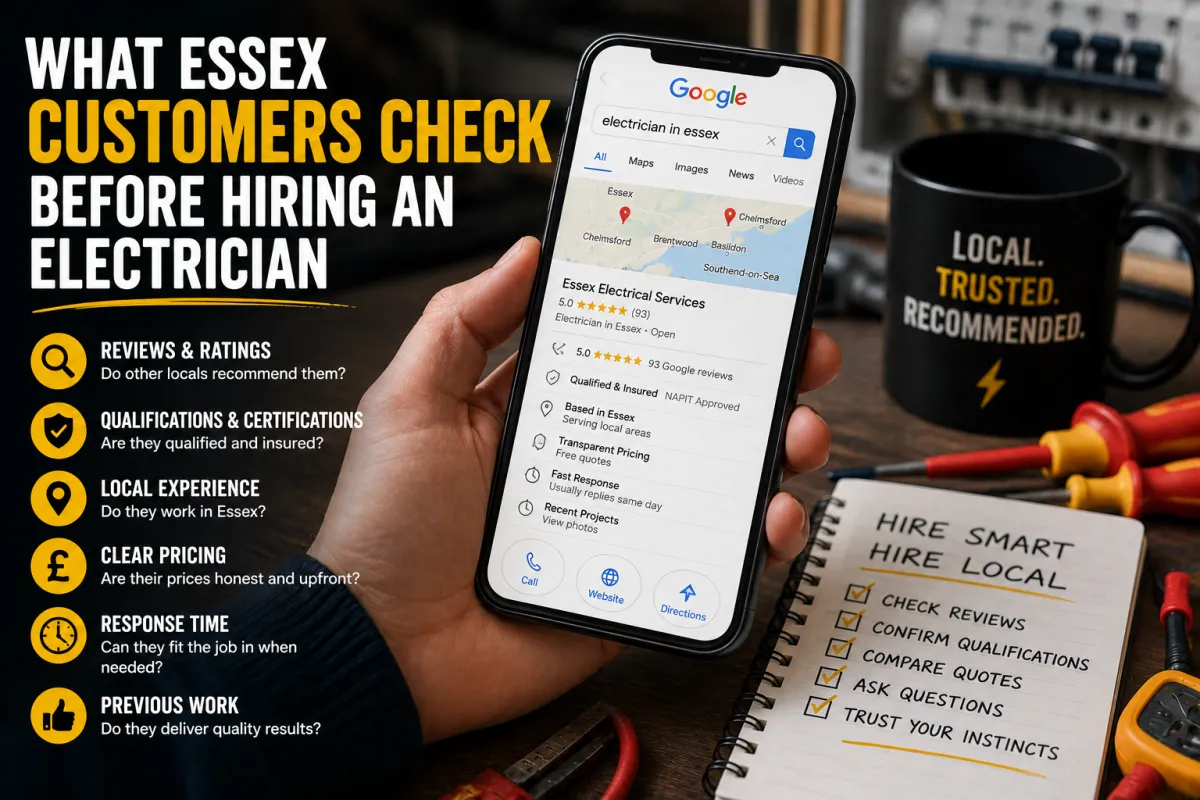
What Essex Customers Check Before Hiring an Electrician
A customer may forgive a decorator for missing a small patch behind a radiator.
They’re less relaxed when someone is working on the electrics.
Electrical faults aren’t always visible. A socket can look ordinary while a loose connection overheats behind it. A recently fitted light can work while the installation itself has problems. A consumer unit may appear neat to the homeowner, who has no way to assess the testing, protection or workmanship behind it.
That creates a different level of concern.
Customers need more than a friendly photograph and a claim that the electrician is “fully qualified”.
They need evidence.
A strong electrician website makes competence easier to verify. It also explains what the customer receives, how the work will be managed and who takes responsibility for certification.
“FULLY QUALIFIED” NEEDS SUPPORTING INFORMATION
The phrase appears on countless trade websites.
It sounds reassuring without telling the customer what it means.
A more credible website should state which registration scheme the business belongs to, the registered business name, the registration number where appropriate, which types of work the registration covers, relevant qualifications or specialist training, whether the business carries public liability insurance, whether employees or subcontractors may attend and how customers can verify the business.
Electrical Safety First strongly recommends using a registered electrician for installation and repair work. Registered electricians work to BS 7671, are assessed and insured, and provide certification confirming that work has been inspected and tested.
Source: https://www.electricalsafetyfirst.org.uk/find-a-registered-electrician/
Government-approved registration bodies operating in England include NICEIC, NAPIT and BFC. A website should display the scheme the electrician actually belongs to, without borrowing badges or vague wording from elsewhere.
A useful sentence might read:
We’re registered with NAPIT under business number XXXXX and carry out domestic electrical installation, inspection and testing across Chelmsford and Mid Essex. You can verify our registration through the official register.
That gives the customer something concrete to check.
REGISTRATION AND QUALIFICATIONS AREN’T THE SAME THING
Customers often use “qualified”, “registered”, “approved” and “certified” as though they mean exactly the same thing.
The website can explain the position in plain English.
Qualifications show training and assessment.
Registration with an approved competent-person scheme allows an electrician to self-certify certain work for Building Regulations purposes, subject to the scope of that registration.
Competence also depends on the type of work.
An electrician may be experienced in domestic installation but may not offer commercial inspection, solar work, battery systems or EV charger installation.
The website should explain its actual scope.
This prevents customers assuming that every electrician provides every electrical service.
EXPLAIN PART P WITHOUT TURNING THE PAGE INTO A TEXTBOOK
Customers may have heard of Part P while planning a rewire, consumer unit replacement or extension.
They may have little idea what it means.
Part P forms part of the Building Regulations in England and Wales. It requires electrical installation work in homes to be designed and installed to protect people from fire and electric shock. Most fixed electrical work must comply, and certain work must either be notified through building control or carried out by someone registered with an approved scheme.
A customer-friendly explanation could say:
Electrical work in your home must comply with the Building Regulations. Where the work is notifiable, our registration allows us to handle the notification and arrange your Building Regulations Compliance Certificate.
That tells the customer what the electrician does for them.
The website doesn’t need to reproduce the regulations. It needs to show that the business understands its responsibilities.
TELL CUSTOMERS WHICH CERTIFICATE THEY’LL RECEIVE
Certificates are one of the weakest areas on many electrical websites.
A site may promise that work is “fully certified” without naming the document.
Customers deserve greater clarity.
Depending on the work, they may receive:
ELECTRICAL INSTALLATION CERTIFICATE
This is generally used for new installations, circuit additions and significant alterations.
It records information about the design, construction, inspection and testing of the installation.
MINOR ELECTRICAL INSTALLATION WORKS CERTIFICATE
This may apply to smaller alterations or additions that don’t include a new circuit.
BUILDING REGULATIONS COMPLIANCE CERTIFICATE
This confirms that relevant notifiable work has been reported for Building Regulations purposes through the electrician’s registration scheme.
ELECTRICAL INSTALLATION CONDITION REPORT
An EICR reports on the condition of an existing installation following inspection and testing.
It isn’t a certificate for newly completed work.
Electrical Safety First explains that customers using a registered electrician for applicable work should receive an Electrical Installation Certificate or Minor Works Certificate confirming compliance with BS 7671, along with a Building Regulations Compliance Certificate where required.
Source: https://www.electricalsafetyfirst.org.uk/find-a-registered-electrician/building-regulations/
The website should state when documents are supplied and how.
For example:
Your electrical certificate will be emailed after testing and completion. Where the work requires Building Regulations notification, the compliance certificate is issued separately through our registration scheme.
This prevents confusion after the job.
MAKE EICRS UNDERSTANDABLE
The term EICR appears on electrical websites across Essex.
Landlords often know they need one. Homeowners may encounter the term during a purchase, renovation or investigation into older wiring.
Few customers understand what the inspection involves.
An effective EICR page should explain what an EICR assesses, who may need one, what parts of the installation are inspected and tested, whether power will be interrupted, how long the inspection may take, why access to sockets, switches and the consumer unit matters, how the report is delivered, what happens when defects are found and whether remedial work is quoted separately.
The page should avoid promising that every property will “pass”.
An EICR exists to report on the condition of the installation. The electrician can’t responsibly guarantee the outcome before inspecting it.
EXPLAIN THE EICR CODES CORRECTLY
Customers can panic when they see codes on a report.
A website can remove some of that fear.
Under current government guidance:
C1 means danger is present and there is a risk of injury.
C2 means a condition is potentially dangerous.
C3 means an improvement is recommended.
FI means further investigation is required without delay.
C1, C2 and FI findings affect whether the installation is considered satisfactory. C3 alone is a recommendation and doesn’t make the report unsatisfactory.
The electrician’s website can explain what happens next:
Where the report identifies remedial or investigative work, we’ll explain each observation in plain English and provide a separate quotation where requested. We won’t begin additional chargeable work without agreement unless immediate action is needed to make a dangerous situation safe.
That demonstrates professionalism.
LANDLORDS NEED DEADLINES, DOCUMENTS AND COMMUNICATION
A landlord may care as much about administration as the inspection itself.
They may be managing several properties, tenants and legal deadlines.
In England, landlords must arrange electrical inspection and testing at intervals of no more than five years, obtain a report and provide copies to tenants and councils within specified periods. Required remedial or investigative work must be completed within the period stated in the report, with a maximum of 28 days under the regulations.
A landlord service page should explain booking lead times, access arrangements, tenant communication, report turnaround, invoice details, remedial quotations, evidence supplied after repairs, portfolio arrangements, letting-agent communication and areas covered.
This shows that the electrician can manage the whole process.
The regulations now also cover social rented properties. Existing social tenancies fell within the extended regime from May 2026, with transitional inspection requirements continuing into November 2026. That may create opportunities for electrical contractors able to support housing providers and larger property portfolios.
An electrician targeting that market needs a website that looks capable of handling organised, documented work.
CUSTOMERS WANT TO KNOW WHAT THE QUOTATION INCLUDES
Electrical quotations can be difficult for homeowners to compare.
One quote may include testing, certification, waste removal and accessories.
Another may cover labour and basic materials, with several items charged separately.
The cheapest headline figure may become the more expensive job.
A website can prepare customers by explaining the quotation structure.
For example:
Written quotations describe the agreed work, main materials, testing and certification. Any exclusions, such as plastering, decorating or specialist access equipment, will be stated before work begins.
This one paragraph can prevent many disputes.
For larger work, the website might also explain deposit requirements, stage payments, quotation validity, changes requested during the project, parking or access costs, who supplies fittings, making good, waste disposal, working hours and delays caused by other trades.
Clear commercial terms create confidence.
BE HONEST ABOUT CONSUMER UNIT UPGRADES
Customers often hear that they need a “new fuse box”.
Some arrive expecting a quick exchange.
The existing installation may need assessment and testing before work can proceed safely. Faults or deficiencies elsewhere can affect the project.
A useful consumer unit page should explain the difference between a fuse box and consumer unit, why an older unit may need inspection, why the electrician needs to assess earthing and bonding, whether an EICR is recommended, why existing circuit faults may appear during testing, which protective devices are proposed, how circuits will be labelled, how long the supply may be disconnected and what certification follows.
The wording should avoid implying that every older consumer unit is automatically dangerous or that every property needs replacement.
A registered electrician should inspect the installation and give advice based on its condition.
Honesty builds more trust than fear.
DESCRIBE WHAT HAPPENS DURING A REWIRE
A full rewire is a major project.
Customers know there will be disruption. They often have no idea how much.
The website should address:
Will carpets and floorboards need lifting?
Will walls be chased?
Can the customer remain in the property?
How are appliances managed?
How many days will the work take?
Will there be temporary power?
When should plastering happen?
Can the electrician coordinate with builders and kitchen fitters?
Are fittings included?
What testing takes place at the end?
Does the quote cover making good?
A careful answer may be:
Every property is different. We inspect the building before quoting and explain likely cable routes, access requirements and disruption. Where walls need chasing or floors need lifting, this will be discussed before work begins. The quotation will state whether making good is included.
That manages expectations without making promises before a survey.
EV CHARGER CUSTOMERS NEED AN ASSESSMENT
An EV charger isn’t simply another appliance attached to the nearest cable.
The electrician may need to assess available electrical capacity, the existing consumer unit, earthing arrangements, protective devices, cable route and length, charger position, parking layout, load management, data or mobile connectivity, manufacturer requirements and distribution network involvement where applicable.
Local Essex providers commonly promote EV charging alongside consumer unit assessment and electrical testing, reflecting the link between charger installation and the wider condition of the property’s electrical system.
The website should explain that a quotation may require photographs, a remote survey or a site visit.
It should also state which charger brands the electrician installs and whether customer-supplied units are accepted.
REAL PHOTOGRAPHS PROVE MORE THAN BADGES
Registration logos matter.
They shouldn’t be the only proof.
Real project photographs can show neat workmanship, clear circuit labelling, suitable containment, care around finished interiors, testing equipment, completed EV installations, organised first-fix work, commercial projects, difficult access handled safely and clean working areas.
The customer may not understand every technical detail.
They can still see whether the work looks organised and whether the electrician takes pride in it.
Captions make photographs more useful.
Consumer unit upgrade in a four-bedroom home near Braintree, completed before the installation of an EV charger. The work included assessment, testing, circuit identification and certification.
That connects the image to a real customer need.
REVIEWS SHOULD DESCRIBE THE EXPERIENCE
“Excellent electrician. Five stars.”
It helps, although it tells the reader very little.
Detailed reviews answer questions.
A strong review might mention the type of work, whether the electrician arrived when promised, how the quote compared with the final invoice, cleanliness, communication, explanations, certification, working around children or pets, coordination with other trades and the town where the job took place.
For example:
We needed a consumer unit upgrade and several faults corrected before renting our property in Brentwood. The findings were explained clearly, the remedial quote matched the final bill and all documents arrived by email the following day.
That review speaks directly to another landlord.
The website should place reviews beside the relevant service.
CUSTOMERS CARE ABOUT WHO ENTERS THEIR HOME
Many electrical jobs take place inside occupied properties.
The customer may be working from home, caring for children, supporting an older relative or managing pets.
They may feel uneasy about allowing an unfamiliar person access to bedrooms, lofts and storage areas.
The website can explain who attends appointments, whether identification is carried, how arrival times are confirmed, whether shoe covers or floor protection are used, how power interruptions are discussed, how furniture and belongings should be prepared, whether waste is removed, how the work area is left and who the customer contacts with concerns.
These details feel ordinary to the electrician.
They matter greatly to the customer.
AVOID EMPTY TRUST PHRASES
“Reliable.”
“Professional.”
“Quality workmanship.”
“Customer-focused.”
Any business can type those words.
Evidence makes them believable.
Instead of saying “We’re reliable”, say:
We confirm appointments by text and contact you when we’re on the way.
Instead of “We provide quality workmanship”, say:
All installation work is inspected and tested, with the appropriate electrical certificate supplied after completion.
Instead of “We’re tidy”, say:
We protect flooring where required, remove electrical waste included in the quotation and leave the immediate work area ready for the next stage.
Specific details create trust.
BUILD A PROPER ABOUT PAGE
The about page should answer the questions a cautious customer may have.
Who owns the business?
How long have they worked in the trade?
Which parts of Essex do they know well?
Do they work alone or manage a team?
Which services do they specialise in?
What registration do they hold?
Why did they start the company?
What type of customer do they usually work with?
A real photograph matters.
A sole trader doesn’t need to appear like a national company. Many customers prefer knowing exactly who will arrive.
A small business can look professional while remaining personal.
RUN THE CUSTOMER CONFIDENCE TEST
Open the website and imagine you’re asking someone to replace your consumer unit, rewire the house, inspect a rental property, install an EV charger or investigate a burning smell.
Can you verify the business?
Can you see who will attend?
Can you understand the process?
Can you tell which certificate you’ll receive?
Can you find real work and detailed reviews?
Can you request a written quotation?
Can you see where the electrician works?
Any missing answer creates hesitation.
Electrical customers need confidence before they book.
The strongest websites earn it with specific proof.
FREQUENTLY ASKED QUESTIONS
What should an electrician display on their website?
Display the business name, service area, contact details, registration scheme, genuine qualifications, insurance information where appropriate, customer reviews and examples of completed work. All claims should be accurate and verifiable.
Is NICEIC registration a legal requirement for electricians?
NICEIC is one of several approved registration bodies. Electricians may belong to another government-approved scheme, such as NAPIT or BFC. The relevant point is whether the electrician is competent and appropriately registered for the work being offered.
What certificates should a customer receive after electrical work?
The document depends on the work. It may include an Electrical Installation Certificate, Minor Electrical Installation Works Certificate, Building Regulations Compliance Certificate or EICR. The electrician should explain which documents apply before work begins.
Does every electrical job need Building Regulations notification?
No. Notification requirements depend on the type and location of the work. All electrical installation work must still comply with applicable safety and Building Regulations requirements.
Can an electrician guarantee a satisfactory EICR?
No responsible electrician can guarantee the result before inspection and testing. The report records the condition of the existing installation and may identify dangerous, potentially dangerous or recommended improvements.
What does C2 mean on an EICR?
C2 means a potentially dangerous condition has been identified. Under landlord electrical safety rules, C2 observations require remedial action within the specified period.
Should electricians publish their registration number online?
Publishing accurate registration details helps customers verify the business. The electrician should follow the branding and display rules of their registration scheme.