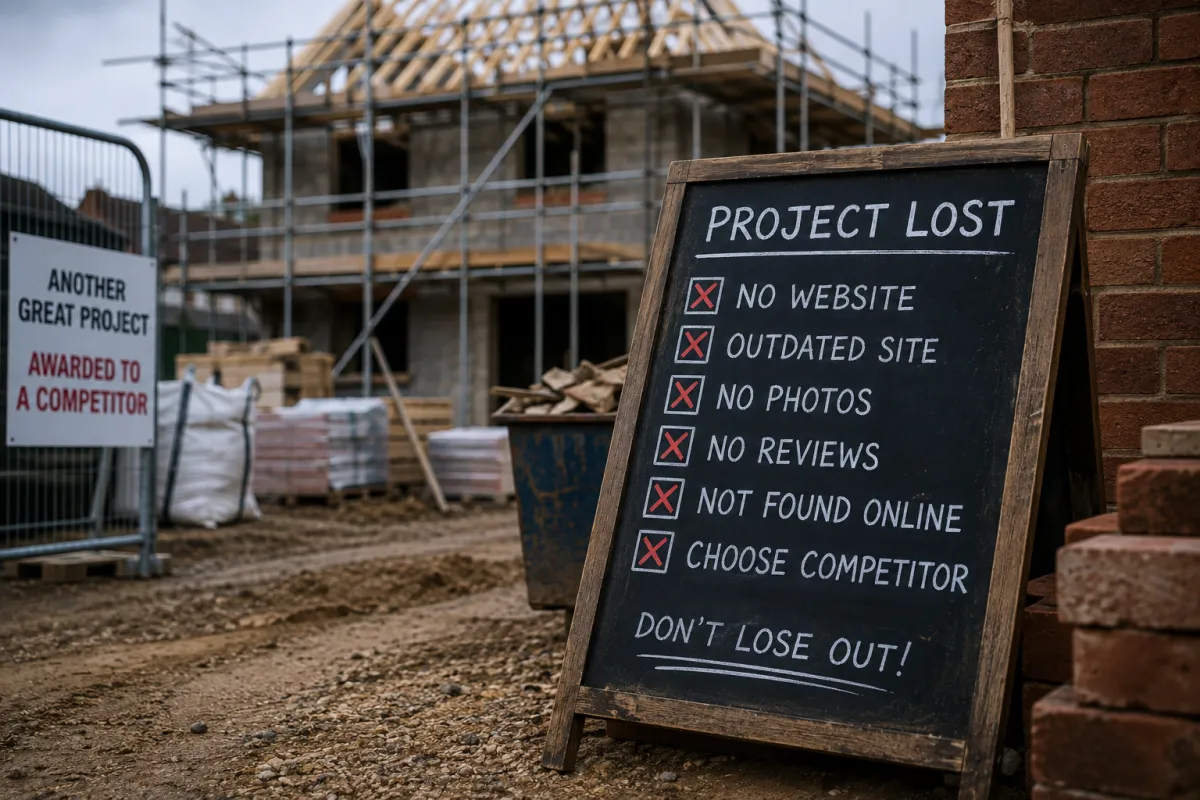
Why Essex Builders Lose Their Best Projects Online
A builder can be booked solid and still feel that the business is going nowhere.
The diary is full, yet too much of the week disappears into small repairs, awkward journeys and jobs that grow without becoming more profitable. Evenings are spent visiting properties, measuring rooms and preparing quotations for people who never reply.
Meanwhile, another local builder appears to be winning extensions, major renovations and whole-property projects.
That doesn’t automatically mean the other builder is better.
They may simply be easier to find, easier to understand and easier to trust.
The homeowner planning a £60,000 extension may never reach your quotation stage. They search online, look at several websites and contact the two builders who seem most suited to their project.
Your name never enters the conversation.
That is the extension enquiry you never saw.
BEING BUSY CAN HIDE THE WRONG TYPE OF WORK
A full diary sounds like success.
It can also hide a business that depends on whichever jobs happen to arrive.
A typical week may include fixing a garden wall, replacing damaged plasterboard, adjusting a door, repairing cracked rendering and visiting three properties to discuss work that hasn’t been designed or costed properly.
Every job has value. The problem appears when small, unpredictable work leaves no space for the projects that could move the business forward.
A builder may want more:
Single-storey extensions
Double-storey extensions
Full property renovations
Loft conversions
Garage conversions
Structural alterations
Kitchen extensions
Commercial refurbishments
Landlord renovation work
Insurance repair projects
Their website may still say:
“All aspects of building work undertaken. No job too big or too small.”
That sentence gives the customer no reason to believe the builder is especially suited to a major project.
It also invites every type of enquiry, including the work the builder would prefer to leave behind.
HOMEOWNERS SEARCH FOR THE PROJECT THEY WANT
Most customers aren’t searching for a list of construction skills.
They’re searching for the result they want to create.
A homeowner might search for:
House extension builder Chelmsford
Kitchen extension company Brentwood
Full house renovation Basildon
Loft conversion builder in Essex
Garage conversion Billericay
Builder for structural alterations Colchester
Open-plan kitchen builder near me
Builders for period property renovation Essex
A website built around “general building services” may struggle to feel relevant to any one of those searches.
The homeowner planning a rear extension wants to see extensions.
They want to understand the process, likely disruption, required permissions, payment stages and the type of team that will be working at their home.
A short list containing brickwork, plastering, carpentry, plumbing, decorating and groundwork doesn’t answer those questions.
STOP MARKETING INDIVIDUAL SKILLS AND START MARKETING COMPLETE PROJECTS
Building businesses often describe themselves by listing the trades involved.
That makes sense inside the industry. It can leave homeowners confused.
A customer doesn’t always know that their project may require groundworks, foundations, drainage changes, brickwork, steel installation, roofing, insulation, plastering, first-fix plumbing, first-fix electrics, joinery, second-fix work, flooring, decorating and building control inspections.
They know they want a larger kitchen.
They want someone to turn a set of drawings into a finished room.
The website should connect the construction work to that desired outcome.
Instead of:
“We provide brickwork, groundwork, roofing and plastering.”
Use:
“We manage home extensions from the first excavation through to plastered, ready-to-decorate rooms. This includes foundations, drainage, structural work, roofing, internal walls and coordination with qualified electrical and plumbing trades.”
The second version helps the customer picture the complete project.
It also shows that the builder understands how the different stages connect.
CHOOSE THE WORK THE WEBSITE SHOULD ATTRACT
A builder’s website should reflect the direction of the business.
Imagine a builder currently receives a mixture of repairs and small alterations. Over the next two years, they want to focus on extensions between £40,000 and £120,000, full internal renovations, structural remodelling and selected loft and garage conversions.
Those services should dominate the website.
Small building work can still be mentioned. It doesn’t need to occupy the most valuable parts of the home page.
A useful exercise is to look at the last twenty jobs and ask:
Which produced the best profit?
Which ran most smoothly?
Which led to strong photographs and recommendations?
Which suited the team’s experience?
Which customers paid on time and communicated clearly?
Which work would you happily repeat?
The answers should shape the website.
A BUILDER NEEDS TO QUALIFY PROJECTS BEFORE VISITING
Many building enquiries arrive too early.
The homeowner has an idea, although they haven’t established whether it needs planning permission, Building Regulations approval, drawings, structural calculations or a realistic budget.
The builder visits anyway.
An hour disappears at the property. Another hour goes into travel. The evening is spent discussing rough figures. The customer then discovers that their expected budget covers half the work.
A website can’t eliminate every unsuitable enquiry. It can prepare customers before they request a visit.
A project enquiry form could ask:
What type of work are you planning?
What is the property postcode?
Do you own the property?
Do you have architectural drawings?
Has planning permission been granted?
Have you spoken to building control?
Do you have structural calculations?
What stage has the project reached?
What is your intended budget range?
When would you like work to begin?
Will the property be occupied?
Can you upload plans or photographs?
This isn’t about putting customers off.
It helps the builder understand whether the project is ready for a meaningful conversation.
EXPLAIN THE DIFFERENCE BETWEEN PLANNING AND BUILDING REGULATIONS
Homeowners frequently use planning permission and Building Regulations as though they’re the same approval.
They cover different parts of a project.
Planning permission concerns what may be built, including the use, size, appearance, location and effect on the surrounding area. Building Regulations govern how work is constructed, covering matters such as structural safety, fire safety, ventilation, drainage, insulation, energy use and accessibility. A project may need one, both or neither, depending on the work and property.
Source: https://www.gov.uk/building-regulations-approval
A builder’s website can explain this simply:
“Planning permission considers whether the proposed development is acceptable. Building Regulations set standards for how the work must be designed and constructed safely. We’ll ask what approvals and drawings you already have before preparing a detailed quotation.”
That paragraph demonstrates experience without positioning the builder as the customer’s planning consultant.
The builder can also explain who normally handles each part.
For example:
“Your architect or planning professional will usually advise on planning applications. Building control inspects key stages of the construction. We work from the approved drawings and coordinate inspection stages as agreed in the contract.”
The exact responsibilities should reflect the builder’s real service.
MAKE CLEAR WHETHER YOU OFFER DESIGN AND BUILD
“Design and build” can mean different things to different companies.
Some builders manage architects, structural engineers, planning applications and construction.
Others begin once approved drawings and calculations are ready.
Both models can work.
The website must make the distinction clear.
A construction-only builder might say:
“We provide quotations once you have sufficiently detailed drawings and structural information. Where you’re still at the ideas stage, we can introduce you to independent local professionals who can help prepare the project.”
A design-and-build company might say:
“We can coordinate the early design, planning, structural and building control stages before managing the construction through to completion.”
Clear wording reduces enquiries from customers who expect a service the business doesn’t provide.
TALK ABOUT REALISTIC PROJECT READINESS
A customer may want their extension completed by Christmas.
It’s already October.
They haven’t appointed an architect, checked planning requirements or considered where the family will live during the work.
The builder who promises to “see what we can do” may create an impossible expectation.
The builder who explains the stages appears more credible.
A website can show a typical route:
Initial discussion
The homeowner explains the proposed work, property, timescale and budget.
Plans and approvals
The required drawings, permissions and structural information are prepared.
Site visit
The builder visits once there is enough detail to understand the scope.
Written quotation
The builder prices the work, identifies assumptions and lists exclusions.
Contract and programme
Both parties agree the scope, payment stages, responsibilities and proposed dates.
Construction
Work begins, with communication and inspections taking place throughout.
Completion and snagging
The project is reviewed, final documents are provided and agreed defects are addressed.
This process turns a vague enquiry into a professional construction project.
SHOW WHY A PROPER QUOTATION TAKES TIME
Homeowners can become frustrated when builders take several weeks to produce a quotation.
Builders can become frustrated when they spend hours pricing a project for someone collecting figures with no intention of starting.
A website can improve understanding on both sides.
Explain what a detailed quotation may involve:
Reviewing plans
Measuring the site
Checking access
Assessing drainage and ground conditions
Obtaining material prices
Contacting subcontractors
Pricing waste removal
Considering scaffolding and plant
Checking structural information
Identifying exclusions
Building a realistic programme
Citizens Advice distinguishes a quotation from an estimate. Its guidance describes a quotation as an agreed price for defined work, while an estimate is an approximate figure. It advises customers to get quotations in writing with the work, materials, VAT position and circumstances in which the cost may change clearly stated.
A builder can say:
“We provide detailed written quotations for projects with suitable plans and information. Early budget figures are indicative until the scope, specification and site conditions have been properly reviewed.”
That protects the builder from being held to a casual figure mentioned during an early conversation.
USE BUDGET GUIDANCE CAREFULLY
Many builders avoid mentioning money online.
That is understandable. Building costs vary according to size, specification, access, ground conditions, structural requirements, finishes and location.
Silence can create more wasted visits.
The website can discuss how budgets are formed without publishing fixed prices.
For example:
“Two extensions with the same floor area can have very different costs. Steelwork, glazing, kitchens, drainage, access, roof design and internal finishes all affect the quotation. We’ll ask about your intended specification and budget so we can establish whether the project is a sensible fit before arranging a detailed visit.”
The builder may also use broad project bands in the enquiry form:
Under £20,000
£20,000 to £40,000
£40,000 to £75,000
£75,000 to £125,000
Above £125,000
Still establishing the budget
These bands should match the builder’s preferred project values.
The purpose is to start an honest conversation.
DEFINE A SENSIBLE ESSEX SERVICE AREA
Claiming to cover all of Essex can attract impressive numbers of enquiries.
It may also create hours of unpaid travel.
A builder based in Chelmsford may happily take an extension in Braintree, Maldon or Billericay. A small repair near the far edge of the county may make little commercial sense.
The website can vary coverage by project size:
“We undertake extensions, renovations and larger building projects across Mid and South Essex. Smaller repairs and alterations are generally limited to Chelmsford and the surrounding area.”
That feels reasonable.
The builder could describe a core area and a wider project area:
“Our core area includes Chelmsford, Great Baddow, Broomfield, Danbury, Billericay and Maldon. We travel further across Essex for substantial renovation and extension projects.”
Google allows service businesses to define their coverage by towns, postcodes or other areas on their Business Profile. Google advises that the overall service area should normally remain within about two hours’ drive of the business base.
Source: https://support.google.com/business/answer/10514743?hl=en-GB
The website and Google profile should describe the same genuine working area.
CASE STUDIES SHOULD PROVE PROJECT CAPABILITY
A gallery containing finished kitchens and freshly painted walls may look attractive.
It doesn’t show how the project was managed.
A useful case study explains:
What the customer wanted
The property type
The location
The original problem
The approved design
The main construction stages
Any complications
How the team responded
The duration
What was included
The finished result
A case study might begin:
REAR EXTENSION AND GROUND-FLOOR RENOVATION IN BRENTWOOD
“The owners wanted to replace a narrow kitchen and separate dining room with a larger family space opening onto the garden. The project involved a rear extension, internal structural alterations, new drainage, steel installation and coordination with the kitchen supplier.”
It can then show groundwork, brickwork, steelwork, roofing, plastering and completion.
The finished room matters.
The journey proves the builder’s ability.
SHOW PROJECTS AT DIFFERENT STAGES
Customers often see only polished completion photographs.
Builders understand that the hidden stages determine whether a project succeeds.
Use photographs of site preparation, foundations, drainage, blockwork and brickwork, damp-proofing, structural steelwork, roof construction, insulation, first-fix services, plastering, joinery, finishing work, snagging and completion.
Add short explanations.
For example:
“New steel installed to support the rear wall before the original ground-floor rooms were opened into one space.”
That tells a far stronger story than “work in progress”.
EXPLAIN WHO MANAGES SUBCONTRACTORS
A homeowner may assume the main builder provides every trade directly.
The project may involve employed trades, regular subcontractors, specialists appointed by the builder and contractors chosen by the homeowner.
Confusion creates gaps and delays.
The website can explain the normal arrangement:
“We manage the core building work and coordinate our regular electrical, plumbing, roofing and plastering trades. Where the homeowner appoints a separate kitchen company or specialist supplier, their responsibilities and programme dates are agreed before construction begins.”
Citizens Advice recommends that written building contracts cover materials, equipment, payment and whether subcontractors will be used.
A clear website prepares the customer for that discussion.
YOUR AVAILABILITY CAN BE A SELLING POINT
Some builders worry that admitting to a waiting list will lose work.
For planned extensions and renovations, immediate availability can raise more questions than reassurance.
A homeowner investing a substantial sum expects a capable builder to have existing commitments.
The website can say:
“Larger projects are normally booked several months ahead. Contact us early so we can review your plans, discuss likely timescales and advise whether the proposed start date is achievable.”
The Federation of Master Builders advises homeowners that good builders are often booked months in advance and recommends planning ahead.
This filters customers who need an unrealistic start date and encourages serious prospects to contact the builder earlier.
BUILD A WEBSITE THAT SAVES TIME BEFORE THE FIRST VISIT
The best builder website doesn’t simply generate more enquiries.
It generates better-prepared enquiries.
A suitable customer should reach the first conversation understanding what projects the builder takes on, which parts of Essex they cover, whether plans are needed, whether the builder offers design support, how quotations work, what information to provide, how far ahead projects are booked, what the construction process looks like, who manages specialist trades and what happens after the enquiry.
That customer is more likely to provide useful plans, discuss a realistic budget and respect the time required to prepare a detailed quotation.
RUN THE LOST-PROJECT TEST
Search for the type of work you most want.
Try:
Extension builder in your town
Home renovation company near you
Garage conversion builder in your area
Builder for structural alterations in Essex
Open your website on a mobile phone.
Can a homeowner see examples of that exact project?
Can they understand your process?
Can they identify your working area?
Can they tell whether you manage complete projects?
Can they find your insurance, reviews and business details?
Can they upload drawings?
Can they request a structured conversation?
When the answer is unclear, your strongest potential customer may leave before you know they existed.
FREQUENTLY ASKED QUESTIONS
Does a busy builder still need a website?
Yes. A website can help a busy builder attract the projects they prefer, filter unsuitable enquiries and prepare customers before a site visit. It can also reduce reliance on recommendations and trade directories.
Should a builder list every service they provide?
The website should cover genuine services, with the greatest emphasis placed on the work the business wants more of. A builder seeking extensions and renovations shouldn’t give small repairs the same prominence.
Should builders publish prices online?
Fixed prices are rarely suitable for complex projects. Builders can explain the factors affecting cost, the budget ranges they work within and the difference between an early estimate and a detailed quotation.
Should builders charge for quotations?
Some builders provide free quotations for well-defined projects, while others charge for detailed pricing or pre-construction work. The website should explain the policy before arranging a visit.
What should a building enquiry form ask?
Ask about the project type, postcode, ownership, drawings, planning status, structural information, budget, timescale, occupation and any documents or photographs the customer can provide.
How far should an Essex builder travel?
The answer depends on project value, team structure and travel time. A builder may use a smaller area for repairs and a wider area for extensions, renovations and commercial projects.
Do builders need separate pages for extensions and renovations?
Separate pages are useful when these services form an important part of the business. Each page can answer project-specific questions, show relevant work and direct the customer towards a suitable enquiry form.