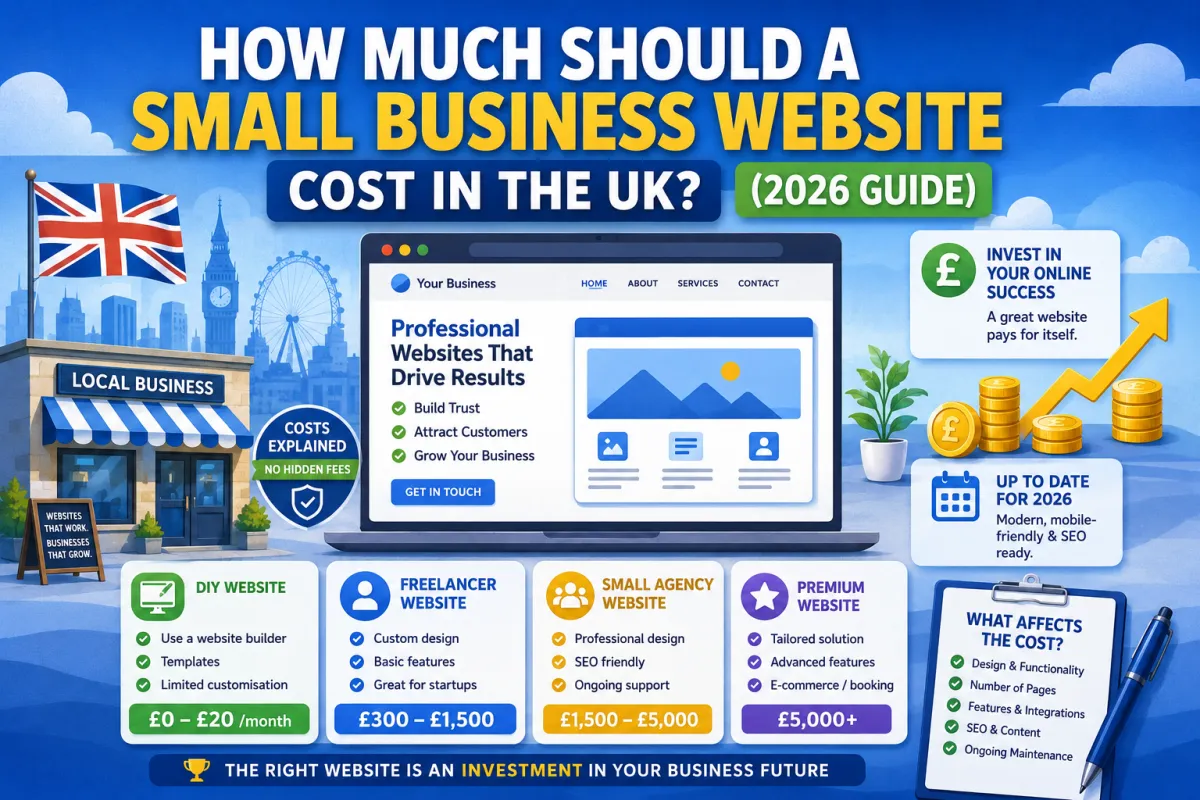
How Much Should a Small Business Website Cost in the UK? (2026 Guide)
If you have ever searched for how much a small business website costs in the UK, you have probably seen prices that make no sense at all.
One site promises a website for under £100. Another quotes several thousand pounds for something that, on the surface, looks similar. It is no wonder small business owners feel confused, cautious, or slightly suspicious.
The truth is that there is no single “correct” price for a website. The cost depends on what the website needs to do for your business, how much work is involved behind the scenes, and whether you are paying for a quick online presence or a proper business tool.
How Long SEO Actually takes to work
This guide breaks down website costs in plain English. No jargon, no scare tactics, and no pressure to spend more than you need. Just a realistic look at what small businesses in the UK actually pay, what affects the price, and how to decide what makes sense for you.
Why Website Prices Vary So Much
Website prices vary because not all websites are built for the same purpose.
Some websites exist purely to say, “Yes, we are a real business.” Others are expected to bring in enquiries, rank on Google, and quietly support sales every day. Those two jobs require very different levels of work.
Another big reason prices differ is how the website is built.
A DIY website builder uses pre-made layouts and tools that let you do most of the work yourself. A professional website involves someone planning the structure, setting up the pages properly, making sure it works on all devices, and often preparing it for search engines.
There is also a difference between a one-off build and an ongoing service. Some prices cover only the initial setup. Others include hosting, updates, security, and support over time. When you see a very low price, it is worth checking what happens after launch.
Finally, experience matters. Someone who has built hundreds of small business websites will charge differently from someone just starting out. That does not automatically mean expensive is better, but it does explain part of the gap.
What clients think of you based on your website.
Typical Small Business Website Cost Ranges in the UK
Rather than giving one number, it is more useful to look at realistic price ranges and what you usually get at each level.
DIY Website Builders (£0 to £500 per year)
This option usually involves platforms where you choose a template, add your text and images, and publish the site yourself.
For very new businesses, side projects, or people who enjoy doing things themselves, this can be a perfectly reasonable starting point. The main costs are subscription fees, a domain name, and your time.
The trade-off is flexibility and performance. DIY sites often struggle with custom layouts, local SEO, and scaling as the business grows. Many business owners also underestimate how long it takes to write content, organise pages, and make everything look coherent.
This option is cheapest financially, but it usually costs the most in time and effort.
Budget Professional Websites (£500 to £1,500)
This is the range many small businesses aim for first.
At this level, you would typically expect a professionally built website using a structured template, a small number of pages, mobile-friendly design, and basic SEO setup. Hosting is sometimes included, sometimes separate.
This works well for businesses that want something tidy, credible, and functional without unnecessary extras. It is often a good middle ground for trades, local services, and solo businesses.
The main thing to watch is what is not included. Copywriting, ongoing SEO, changes after launch, and long-term support are often outside the initial price.
Mid-Range Websites (£1,500 to £5,000)
This level is more common for established businesses that rely on their website to generate regular enquiries.
You are paying for more planning, more tailored design, better SEO foundations, and usually a clearer focus on conversions. Content structure, service pages, and local search visibility tend to be handled more carefully here.
For many growing small businesses, this level makes sense once the website is directly linked to income rather than just credibility.
What Actually Affects Website Cost
Once you move past headline prices, website costs start to make more sense. Most of the variation comes down to a few practical factors rather than anything mysterious.
Number of Pages
A one-page website is quicker and cheaper to build than a site with ten or fifteen pages. Each additional page needs layout, content, formatting, and checking on different screen sizes.
More pages are not always better. What matters is whether each page has a clear purpose, such as explaining a service, answering a common question, or helping people get in touch.
Who Writes the Content
Content is often where costs quietly increase.
If you write all the text yourself, you reduce the upfront cost. If someone else writes it for you, you are paying for time, experience, and clarity.
Professional copywriting can make a real difference, especially on homepages and service pages, but it is not always essential at the start. Many small businesses begin with simple, clear content and improve it later.
SEO Setup
Some websites are built with search engines in mind from day one. Others are not.
SEO setup usually includes things like page structure, headings, metadata, internal links, and making sure the site can be crawled properly by Google. This work takes time and is often invisible, which is why it is easy to underestimate its value.
A website built without SEO foundations can still look good, but it may struggle to be found.
Design Customisation
Using a standard layout keeps costs down. Customising layouts, colours, spacing, and page elements takes longer and increases the price.
For many small businesses, simple and familiar layouts work better than highly creative ones. Visitors usually care more about clarity and trust than clever design.
Ongoing Support and Changes
Some website prices include support after launch. Others do not.
If you want someone to handle updates, fix issues, or make small changes over time, that support needs to be factored in. Otherwise, you may end up paying extra for every small adjustment.
Ongoing Website Costs People Forget About
One of the biggest surprises for small business owners is that website costs do not stop at launch.
Here are the most common ongoing costs to be aware of.
Hosting
Your website needs somewhere to live. Hosting costs vary, but most small business websites fall into a modest monthly or annual fee. Good hosting helps with speed, security, and reliability.
Maintenance and Updates
Websites need occasional updates to stay secure and functional. This includes software updates, backups, and basic checks. Some providers include this as part of a package. Others charge separately.
SEO and Content
If you want your website to improve its visibility over time, you may invest in SEO work or regular content. This is optional, but it is often what turns a static website into a steady source of enquiries.
Domain and Email
Domain names and business email addresses are usually small annual costs, but they are still worth accounting for.
None of these costs are unreasonable. They just need to be expected.
How to Decide What You Really Need
Instead of asking, “How cheap can I get a website?” a more useful question is, “What do I need my website to do?”
For some businesses, the goal is simply to look credible when someone searches the business name. For others, the website needs to attract local searches, explain services clearly, and encourage people to get in touch.
Ask yourself:
Do I need enquiries from my website, or just an online presence?
Am I competing locally or nationally?
Am I happy to update things myself, or do I want support?
When you are clear on the job your website needs to do, it becomes much easier to judge whether a quote makes sense.
Is a Cheap Website Ever Worth It?
A cheap website can be worth it in the right situation.
If you are just starting out, testing an idea, or need something simple quickly, a low-cost website can be a sensible step. It gets you online and gives you a base to build from.
Problems tend to arise when a cheap website is expected to do more than it was designed for. If you want strong local rankings, steady enquiries, or room to grow, cutting corners at the start can slow you down later.
The key is honesty. A cheap website is not bad. It just has limits.
Think About this
There is no single “right” amount to spend on a small business website in the UK.
What matters is spending in a way that matches your business stage, your goals, and your capacity to manage things yourself. A well-planned, simple website often outperforms a complicated one that no one understands or updates.
If you are unsure what level makes sense for your business, it is usually worth talking it through before committing. A short conversation can save months of frustration and wasted spend.
When you are ready, your website should feel like a useful business tool, not a confusing expense.
Frequently Asked Questions About Small Business Website Costs
How much does a basic small business website cost in the UK?
A basic small business website in the UK typically costs between £500 and £1,500 if it is built professionally. This usually includes a small number of pages, a mobile-friendly layout, and basic setup. DIY website builders can cost less upfront, but they require more time and effort from the business owner.
Is it worth paying for a professional website?
For most small businesses, yes. A professional website helps build trust, explains your services clearly, and supports enquiries. It is particularly valuable if you rely on local customers finding you online. The key is choosing a level of service that matches your needs rather than paying for features you will never use.
Can I start with a cheap website and upgrade later?
Yes, many small businesses do exactly that. Starting with a simple website is often sensible. The important thing is making sure the site is built in a way that allows improvement later, especially if you plan to add SEO, more pages, or extra functionality.
Why do some website designers charge thousands of pounds?
Higher prices usually reflect more time spent on planning, design, content structure, SEO foundations, and ongoing support. These websites are often built to generate leads and support long-term growth rather than just provide an online presence.
What ongoing costs should I expect after my website goes live?
Most small business websites have ongoing costs such as hosting, domain renewal, maintenance, and occasional updates. If you invest in SEO or content, that may also be an ongoing cost. These are normal and help keep the site secure and effective.
Do I need SEO from the start?
You do not need ongoing SEO immediately, but it helps if your website is set up with SEO basics from the beginning. This makes it easier to improve rankings later without having to rebuild the site.
How do I know if a website quote is reasonable?
A reasonable quote clearly explains what is included, what is not included, and what happens after launch. If a price sounds too good to be true or is vague about support and future costs, it is worth asking more questions before agreeing.